

An api for tracking price changes across e-commerce platforms is exactly what it sounds like: a programmatic interface that continuously collects, cleans, and delivers live product price data from online retailers, marketplaces, and competitor websites. Instead of building your own scraping infrastructure, complete with proxy rotation, CAPTCHA solving, and constant schema fixes, you consume a pricing API and get structured data back on demand or through a push delivery like a webhook.
Most of these tools cover core fields: current price, list price, promotional price, availability, and sometimes seller information for marketplace Buy Box tracking. Update frequency ranges anywhere from every 15 minutes for high-priority SKUs to once every 24 hours for lower-priority catalog items, depending on the provider and your subscription tier.
You may read also
- Common Account Audit Software Used in Kenya (2026 Comparison)
- Best Proposal Software for Accountants (2026 Comparison)
- Puzzle.io Reviews: The Full 2026 Breakdown (Features, Pricing, Pros & Cons)
- Sage Accounting vs QuickBooks: Which Accounting Software Should You Choose?
- Accounting Software Implementation Best Practices: The Complete Guide for Small Business
- Inventory and Accounting Software for Small Business:
Why You Need an API for Tracking Price Changes Across E-Commerce Platforms
Manual price checks simply can’t keep pace anymore, which is exactly the gap an api for tracking price changes across e-commerce platforms is built to close. A mid-size retailer selling 50,000 SKUs across five competitor domains would need to track 250,000 data points just for a single check, and that’s before you factor in hourly updates. About 82% of shoppers compare prices online before buying, and 73% of large retailers already use automated repricing tools, so sitting this one out puts you at a real disadvantage.
Beyond competitive tracking, a solid api for tracking price changes across e-commerce platforms also helps with MAP (Minimum Advertised Price) enforcement across every channel you sell through, catching resellers who undercut your brand, and spotting broader market trends before your margins take a hit.
One consumer electronics client using a dedicated pricing API reduced MAP violations by 67% within three months simply by automating what used to be a manual, spot-check process. If you’re scaling a store and weighing funding options at the same time, it’s worth a quick look at shopify capital alternatives too, since growth and pricing intelligence tend to go hand in hand.
Key Features to Look For
Before comparing specific tools, here’s what actually matters when picking any api for tracking price changes across e-commerce platforms:
- Platform coverage. Does it cover Amazon, Walmart, eBay, Google Shopping, or just one?
- Update frequency. Real-time or near-real-time beats a stale daily batch, especially for flash sales.
- Product matching. GTIN, UPC, or ASIN-based matching prevents comparing the wrong products.
- Cost per product. Some tools charge per SKU, others per credit or query, and the math changes dramatically at scale.
- Alerts and automation. Built-in notifications save you from polling the API constantly.
- Compliance. Look for providers that respect robots.txt and avoid circumventing login walls, which keeps your data collection on solid legal ground.
How These APIs Actually Work Under the Hood

Most providers of an api for tracking price changes across e-commerce platforms follow a fairly similar pipeline under the hood, even if the marketing language differs. First, a scheduler assigns collection tasks based on refresh priority, high-velocity SKUs get checked every 15 minutes, while long-tail catalog items might only refresh every few hours. Requests then get dispatched, often through rotating residential or datacenter proxies to avoid getting blocked, and for JavaScript-heavy sites, headless browsers render the page before any data gets pulled.
Once raw data comes back, it passes through validation and normalization, catching obvious errors like a $0 price glitch, converting currencies, and flagging promotional prices separately from standard pricing, a step every reliable api for tracking price changes across e-commerce platforms handles before the data ever reaches you. That distinction matters more than people expect. A flash sale price shouldn’t permanently distort your competitive positioning data, and a good api for tracking price changes across e-commerce platforms builds that filtering in rather than leaving it to you to figure out after the fact.
Common Mistakes When Choosing an API for Tracking Price Changes
A lot of teams pick the wrong api for tracking price changes across e-commerce platforms simply because they compare headline features instead of testing against their actual product catalog, and that mistake gets expensive fast. Marketing pages love to advertise “15-minute updates,” but that number often only applies to a small slice of high-priority SKUs, the rest of your catalog might refresh far less often. Always ask for the P90 or P99 latency across your full SKU list, not just the best-case number.
Another common mistake is ignoring product matching quality. Two nearly identical products can carry completely different identifiers across Amazon, Walmart, and Google Shopping, and a weak api for tracking price changes across e-commerce platforms will compare the wrong items entirely, giving you a false sense of your competitive position.
Testing product matching accuracy before rollout is one of the cheapest insurance policies you can buy against a bad api for tracking price changes across e-commerce platforms decision. Finally, don’t underestimate cost scaling. A tool that looks affordable at 100 products can become prohibitively expensive at 10,000, so always model your real catalog size before signing an annual contract.
Top 5 APIs for Tracking Price Changes Across E-Commerce Platforms
Here’s a closer look at five of the strongest options for an api for tracking price changes across e-commerce platforms available right now, compared on coverage, pricing, and who each one actually fits.
1. Scavio
Scavio has become one of the most talked-about names in the api for tracking price changes across e-commerce platforms space, largely because of how it handles cost at scale. Rather than scraping individual product pages directly, Scavio pulls SERP-based product search data covering Amazon, Walmart, and Google Shopping, letting you track 1,000 products across all three platforms for about $5 per check cycle. That’s a fraction of what dedicated tools like Prisync charge for the same coverage.
Pricing runs at $0.005 per credit, with a $30/month plan covering 7,000 credits, and Scavio also offers an MCP server for teams building agent-driven price monitoring workflows. Because it works from SERP data rather than direct retailer APIs, some listed prices may differ slightly from actual checkout prices, which is worth knowing before you rely on it for penny-perfect Buy Box decisions.
Pros:
- Covers Amazon, Walmart, and Google Shopping in one API
- Extremely cost-effective at scale ($5 per 1,000 products per check)
- Structured product data with prices and availability included
- MCP server support for agent-driven monitoring
Cons:
- SERP-based pricing may miss unlisted deals
- No built-in real-time price change webhooks
- Product matching sometimes needs query optimization
Scavio is one of the best picks among any api for tracking price changes across e-commerce platforms if cross-platform coverage and cost efficiency matter more to you than pinpoint retailer-direct accuracy.
2. Keepa API
Keepa has built its entire reputation around one platform, and among every api for tracking price changes across e-commerce platforms on this list, it does that one thing better than almost anyone else. If your business lives and dies by Amazon specifically, Keepa’s historical price data goes back years, giving you the deepest price-history charts available for any Amazon-focused api for tracking price changes across e-commerce platforms on this list.
Beyond historical charts, Keepa includes built-in price drop alerts, Buy Box tracking, and sales rank data, all accessible through its API at $19/month for 100 tokens per minute. The token-based rate limiting can feel confusing at first, and the fact that it’s Amazon-only means you’ll need to pair it with something else if you sell across multiple marketplaces.
Pros:
- Most comprehensive Amazon price history available anywhere
- Built-in price drop alerts
- Buy Box tracking and sales rank data included
- Affordable at $19/month
Cons:
- Amazon only, no Walmart or Google Shopping coverage
- Token-based rate limiting takes some getting used to
- No cross-platform e-commerce visibility
Keepa wins decisively if Amazon is your entire world, but you’ll need a second tool the moment you expand beyond it.
3. DataForSEO Google Shopping
DataForSEO takes a laser-focused approach to Google Shopping data among tools built for tracking price changes across e-commerce platforms, and it wins on pure per-query cost. At $0.003 per query with no monthly minimum beyond a $50 deposit, it’s genuinely the cheapest option here for high-volume Google Shopping monitoring specifically.
The API delivers detailed merchant and pricing data with global coverage, which makes it useful for businesses tracking international Shopping listings. The trade-off is scope: DataForSEO covers Google Shopping only, with no Amazon or Walmart data, and it operates in queue mode, which adds some latency compared to instant API responses. There’s also no historical price storage built in, so you’ll need to build your own database if trend analysis matters to you.
Pros:
- Cheapest per-query cost for Google Shopping data
- Detailed merchant and pricing information
- No monthly minimum beyond a small deposit
- Genuinely global coverage
Cons:
- Google Shopping only, no Amazon or Walmart
- Queue mode adds noticeable latency
- No built-in historical price storage
DataForSEO makes sense as a narrow, budget-friendly api for tracking price changes across e-commerce platforms specifically when Google Shopping is your primary channel.
4. Prisync
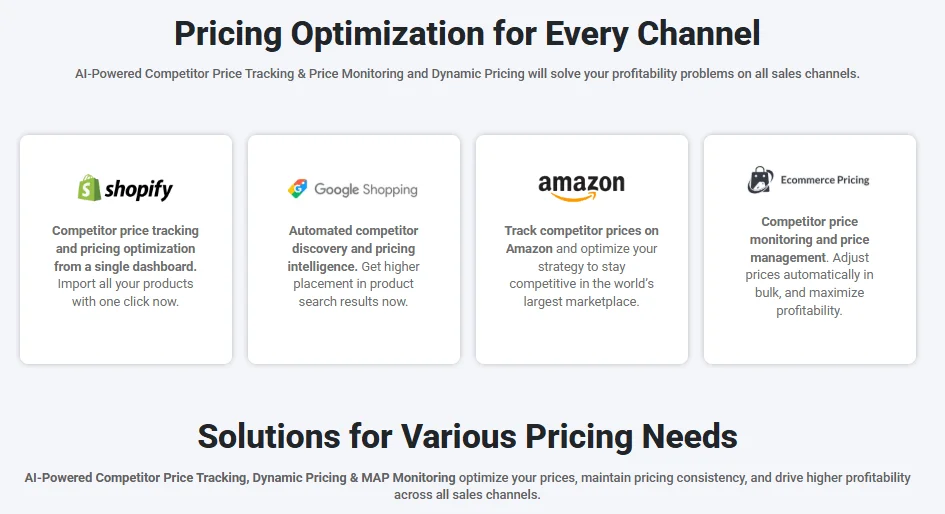
Prisync takes the turnkey route among options for an api for tracking price changes across e-commerce platforms, giving small to medium retailers a full dashboard rather than raw API access alone. It handles competitor price tracking, dynamic pricing rules, and email alerts, plus direct integrations with Shopify and Magento, which makes it approachable for teams without a developer on staff.
Pricing starts at $99/month for 100 products, scaling up considerably as your catalog grows, up to roughly $399/month for 1,000 products. That per-product cost structure is where Prisync starts to feel expensive compared to SERP-based alternatives, and its API access for custom integrations remains fairly limited if you need something more flexible than the built-in dashboard.
Pros:
- Turnkey dashboard requires minimal technical setup
- Automatic competitor detection built in
- Dynamic pricing suggestions included
- Native Shopify and Magento integrations
Cons:
- Expensive per product at scale ($99/mo for just 100 products)
- Limited API access for custom integrations
- Per-product pricing model doesn’t scale efficiently
Prisync is a solid choice if you want a ready-to-use dashboard rather than raw API access, but it’s not the most cost-efficient api for tracking price changes across e-commerce platforms once your catalog grows past a few hundred SKUs.
5. Firecrawl
Firecrawl approaches the api for tracking price changes across e-commerce platforms problem differently than the other four, positioning itself as a general-purpose web scraping API that happens to excel at e-commerce specifically. It extracts structured product data, prices, variants, and inventory, from literally any platform, including custom Shopify or WooCommerce stores that dedicated pricing tools often can’t reach.
What sets Firecrawl apart is how it handles the messy parts of modern e-commerce sites: JavaScript-rendered pricing, dynamic content, and geo-targeted pricing based on location or login state. You define your schema once, and Firecrawl returns consistent JSON across every platform you scrape, whether that’s Amazon, a custom D2C storefront, or twenty different sites at once. Plans start at $16/month, and there’s also a dedicated web monitoring endpoint that only triggers alerts when meaningful price changes actually occur, cutting down on unnecessary polling.
Pros:
- Works on any e-commerce platform, not just major marketplaces
- Handles JavaScript rendering and dynamic pricing automatically
- Affordable starting price at $16/month
- Built-in monitoring endpoint with change-triggered alerts
Cons:
- Requires defining your own extraction schema
- Less specialized than Amazon-only tools like Keepa for deep historical data
- Best results still require some setup for complex sites
Firecrawl rounds out this list as the most flexible api for tracking price changes across e-commerce platforms, especially for teams tracking niche or custom storefronts that other tools simply can’t reach.
Comparing the Top 5 APIs for Tracking Price Changes Across E-Commerce Platforms
| API | Coverage | Starting Price | Best For |
|---|---|---|---|
| Scavio | Amazon, Walmart, Google Shopping | $0.005/credit (~$30/mo) | Cost-efficient multi-platform tracking |
| Keepa API | Amazon only | $19/month | Deep Amazon price history |
| DataForSEO | Google Shopping only | $0.003/query | Budget Google Shopping monitoring |
| Prisync | Multi-platform (dashboard) | $99/month | Turnkey, non-technical teams |
| Firecrawl | Any platform | $16/month | Custom and niche storefronts |
This table should make it easy to compare the best api for tracking price changes across e-commerce platforms without opening five separate pricing pages, whichever specific api for tracking price changes across e-commerce platforms you’re leaning toward.
Price API Free Options and Price Tracker API Basics
If your budget is genuinely zero to start, there are legitimate price API free tiers worth trying before you commit to a paid api for tracking price changes across e-commerce platforms. A price API free trial is usually enough to tell whether the coverage and accuracy actually fit your catalog. Scavio offers 50 free credits on signup with no credit card required, which is enough to test coverage and accuracy against your own product list. Keepa also runs a free browser extension alongside its paid API, which functions as a price API free option if you just want to eyeball Amazon price history before building anything automated.
A basic price tracker API doesn’t need to be complicated to be useful. At its simplest, a price tracker API just needs to hit an endpoint, pull the current price for a SKU, and log it somewhere you can review later. Once you’re comfortable with that basic loop, layering in alerts and historical storage turns a simple price tracker API into a genuine competitive intelligence system.
Price Comparison API Free Tiers Worth Testing
Beyond the dedicated pricing APIs above, a few price comparison API free options are worth mentioning specifically for shopping search data. SerpApi’s price monitoring product includes a free tier offering up to 250 searches a month, covering Google Shopping, Bing Shopping, Walmart, and Home Depot, which is a reasonable way to prototype a price comparison API free of charge before scaling into a paid plan.
DataForSEO’s structure, with no monthly minimum beyond a small deposit, also functions similarly to a price comparison API free trial in practice, since you’re not locked into a recurring subscription just to test the waters. Testing a price comparison API free tier against your actual product catalog, rather than trusting marketing claims, is the single best way to avoid a costly mismatch later.
Other Tools Worth Knowing in This Space
Beyond the top 5 picks for an api for tracking price changes across e-commerce platforms, a handful of other names show up regularly in this category. Price API delivers structured, real-time market data from Amazon, eBay, and Google Shopping in unified JSON, including shipping fees and stock levels.
Apify’s Competitor Price Monitor tool outputs price-change “diffs” from previous runs, which is handy if you specifically want to see what changed rather than a full snapshot every time. Wiser Solutions and DataWeave operate at the enterprise end, tracking billions of data points daily for brands with serious MAP enforcement needs, while WebDataInsights offers a fully managed, enterprise-grade option with 99.9% accuracy claims and dedicated account support for teams that would rather outsource the entire infrastructure.
Who Actually Needs This Kind of Tool
Not every seller genuinely needs an enterprise-grade api for tracking price changes across e-commerce platforms on day one. A small Shopify store with 50 SKUs and no direct marketplace competitors might get by with occasional manual checks or a free tier. But once you’re managing hundreds of SKUs across Amazon, Walmart, or your own storefront simultaneously, an api for tracking price changes across e-commerce platforms stops being optional and starts being the only realistic way to stay competitive.
Brand owners enforcing MAP policies across a reseller network fall into the same category. Without automated tracking, MAP violations get caught through customer complaints or random spot checks, both slow and unreliable. Marketplace sellers fighting to keep the Buy Box also depend heavily on an api for tracking price changes across e-commerce platforms, since Buy Box eligibility can shift within minutes of a competitor’s price drop, far faster than any human could react manually.
Our Recommendation: Why Scavio Is the Best Pick

After comparing all five options directly, Scavio earns our top recommendation as the best overall api for tracking price changes across e-commerce platforms for most sellers. The math is simple: covering Amazon, Walmart, and Google Shopping in a single API for roughly $5 per 1,000 products per check beats paying $99 or more through a dashboard-first tool like Prisync for a fraction of the coverage.
Scavio isn’t a perfect api for tracking price changes across e-commerce platforms, since SERP-based data can occasionally drift from actual checkout prices, and you’ll need to build your own alerting layer rather than relying on built-in webhooks. But for sellers who need broad, affordable, cross-platform visibility without an enterprise budget, it’s genuinely hard to beat. Pair it with Keepa specifically if Amazon-only historical depth matters to your strategy, and you’ve covered nearly every use case this guide discusses.
Frequently Asked Questions
Is there a free API for price tracking? Yes. Scavio offers 50 free credits on signup with no credit card required, and SerpApi’s price monitoring tool includes a free tier of up to 250 searches monthly. Keepa also provides a free browser extension for manual Amazon price checks alongside its paid API.
What API can I use for price comparison? Price API, Scavio, and SerpApi’s Shopping product all work well for price comparison across multiple retailers. Your choice depends on which platforms you need covered, Scavio focuses on Amazon, Walmart, and Google Shopping, while SerpApi adds Bing Shopping and Home Depot to the mix.
Is there an API that can be used to get stock prices? No, the APIs discussed in this guide track retail product prices on e-commerce platforms, not financial stock market prices. For stock market data specifically, you’d want a dedicated financial data API like Alpha Vantage or IEX Cloud instead.
What is an API for eCommerce? An API for eCommerce is a programmatic interface that lets applications interact with online store data, whether that’s pricing, inventory, orders, or product catalogs, without needing to manually access each platform’s website. An api for tracking price changes across e-commerce platforms is one specific category built around tracking product prices at scale.
What’s the best price tracking app? For everyday shoppers, Keepa’s browser extension is a favorite for Amazon-specific price history. For businesses needing automated, cross-platform tracking, Scavio or Firecrawl are stronger picks depending on whether you need broad marketplace coverage or custom site flexibility.
Can I get an API for free? Yes, several providers covered here offer free tiers or trial credits, including Scavio’s 50 free credits and SerpApi’s 250 free monthly searches. Just confirm what counts against your free quota, since credits and queries get consumed faster than expected once you’re tracking real product volume.
Which price comparison site is best? For consumer shopping, Google Shopping and Keepa (for Amazon specifically) remain the most widely used price comparison resources. For business-level price comparison across multiple retailers at once, a dedicated api for tracking price changes across e-commerce platforms like Scavio gives you far more control than any single comparison site.
What is an API for pricing? An API for pricing is a data interface that delivers structured price information, current price, promotional price, availability, and sometimes historical trends, for products across one or more retail platforms. It’s the backbone that powers repricing engines, MAP compliance tools, and competitive intelligence dashboards.
What is the best app to compare prices between different stores? Google Shopping remains the most accessible free option for casual price comparison across stores. For serious sellers tracking their own competitive position programmatically, an api for tracking price changes across e-commerce platforms delivers far more depth and automation than any consumer-facing comparison app.
How much does a price tracking API typically cost? Costs vary widely by provider and model. SERP-based tools like Scavio and DataForSEO charge per credit or query, often just a few dollars per thousand checks, while dashboard-first platforms like Prisync charge per product monthly, which gets expensive fast at scale. Enterprise solutions with dedicated support typically run into custom pricing starting around $500/month or more.
Final Thoughts
Picking the right api for tracking price changes across e-commerce platforms really comes down to your scale and which platforms matter most to your business, and this guide should leave you with a clear shortlist either way. Scavio wins on cost and cross-platform coverage, Keepa dominates for Amazon-only depth, and Firecrawl handles the custom storefronts other tools can’t touch. Whichever you choose, start with a free tier or trial credits before committing, since testing against your actual product catalog beats trusting any vendor’s marketing page every time.
Amazon changes prices roughly 2.5 million times a day, and if you’re not watching, you’re guessing. Finding the right api for tracking price changes across e-commerce platforms is what separates sellers who react fast from sellers who lose the Buy Box and never notice. This guide breaks down what these APIs actually do, compares five of the strongest options on the market, and shows you which one to pick depending on your budget and scale. We’ll also flag a few adjacent tools worth knowing, like shopify capital for funding and a solid b2b commerce platform if you sell wholesale too.
What Is an API for Tracking Price Changes Across E-Commerce Platforms?
An api for tracking price changes across e-commerce platforms is exactly what it sounds like: a programmatic interface that continuously collects, cleans, and delivers live product price data from online retailers, marketplaces, and competitor websites. Instead of building your own scraping infrastructure, complete with proxy rotation, CAPTCHA solving, and constant schema fixes, you consume a pricing API and get structured data back on demand or through a push delivery like a webhook.
Most of these tools cover core fields: current price, list price, promotional price, availability, and sometimes seller information for marketplace Buy Box tracking. Update frequency ranges anywhere from every 15 minutes for high-priority SKUs to once every 24 hours for lower-priority catalog items, depending on the provider and your subscription tier.
Why You Need an API for Tracking Price Changes Across E-Commerce Platforms
Manual price checks simply can’t keep pace anymore, which is exactly the gap an api for tracking price changes across e-commerce platforms is built to close. A mid-size retailer selling 50,000 SKUs across five competitor domains would need to track 250,000 data points just for a single check, and that’s before you factor in hourly updates. About 82% of shoppers compare prices online before buying, and 73% of large retailers already use automated repricing tools, so sitting this one out puts you at a real disadvantage.
Beyond competitive tracking, a solid api for tracking price changes across e-commerce platforms also helps with MAP (Minimum Advertised Price) enforcement across every channel you sell through, catching resellers who undercut your brand, and spotting broader market trends before your margins take a hit. One consumer electronics client using a dedicated pricing API reduced MAP violations by 67% within three months simply by automating what used to be a manual, spot-check process. If you’re scaling a store and weighing funding options at the same time, it’s worth a quick look at shopify capital alternatives too, since growth and pricing intelligence tend to go hand in hand.
Key Features to Look For
Before comparing specific tools, here’s what actually matters when picking any api for tracking price changes across e-commerce platforms:
- Platform coverage. Does it cover Amazon, Walmart, eBay, Google Shopping, or just one?
- Update frequency. Real-time or near-real-time beats a stale daily batch, especially for flash sales.
- Product matching. GTIN, UPC, or ASIN-based matching prevents comparing the wrong products.
- Cost per product. Some tools charge per SKU, others per credit or query, and the math changes dramatically at scale.
- Alerts and automation. Built-in notifications save you from polling the API constantly.
- Compliance. Look for providers that respect robots.txt and avoid circumventing login walls, which keeps your data collection on solid legal ground.
How These APIs Actually Work Under the Hood
Most providers of an api for tracking price changes across e-commerce platforms follow a fairly similar pipeline under the hood, even if the marketing language differs. First, a scheduler assigns collection tasks based on refresh priority, high-velocity SKUs get checked every 15 minutes, while long-tail catalog items might only refresh every few hours. Requests then get dispatched, often through rotating residential or datacenter proxies to avoid getting blocked, and for JavaScript-heavy sites, headless browsers render the page before any data gets pulled.
Once raw data comes back, it passes through validation and normalization, catching obvious errors like a $0 price glitch, converting currencies, and flagging promotional prices separately from standard pricing, a step every reliable api for tracking price changes across e-commerce platforms handles before the data ever reaches you. That distinction matters more than people expect.
A flash sale price shouldn’t permanently distort your competitive positioning data, and a good api for tracking price changes across e-commerce platforms builds that filtering in rather than leaving it to you to figure out after the fact.
Common Mistakes When Choosing an API for Tracking Price Changes
A lot of teams pick the wrong api for tracking price changes across e-commerce platforms simply because they compare headline features instead of testing against their actual product catalog, and that mistake gets expensive fast. Marketing pages love to advertise “15-minute updates,” but that number often only applies to a small slice of high-priority SKUs, the rest of your catalog might refresh far less often. Always ask for the P90 or P99 latency across your full SKU list, not just the best-case number.
Another common mistake is ignoring product matching quality. Two nearly identical products can carry completely different identifiers across Amazon, Walmart, and Google Shopping, and a weak api for tracking price changes across e-commerce platforms will compare the wrong items entirely, giving you a false sense of your competitive position.
Testing product matching accuracy before rollout is one of the cheapest insurance policies you can buy against a bad api for tracking price changes across e-commerce platforms decision. Finally, don’t underestimate cost scaling. A tool that looks affordable at 100 products can become prohibitively expensive at 10,000, so always model your real catalog size before signing an annual contract.
Top 5 APIs for Tracking Price Changes Across E-Commerce Platforms
Here’s a closer look at five of the strongest options for an api for tracking price changes across e-commerce platforms available right now, compared on coverage, pricing, and who each one actually fits.
1. Scavio
Scavio has become one of the most talked-about names in the api for tracking price changes across e-commerce platforms space, largely because of how it handles cost at scale. Rather than scraping individual product pages directly, Scavio pulls SERP-based product search data covering Amazon, Walmart, and Google Shopping, letting you track 1,000 products across all three platforms for about $5 per check cycle. That’s a fraction of what dedicated tools like Prisync charge for the same coverage.
Pricing runs at $0.005 per credit, with a $30/month plan covering 7,000 credits, and Scavio also offers an MCP server for teams building agent-driven price monitoring workflows. Because it works from SERP data rather than direct retailer APIs, some listed prices may differ slightly from actual checkout prices, which is worth knowing before you rely on it for penny-perfect Buy Box decisions.
Pros:
- Covers Amazon, Walmart, and Google Shopping in one API
- Extremely cost-effective at scale ($5 per 1,000 products per check)
- Structured product data with prices and availability included
- MCP server support for agent-driven monitoring
Cons:
- SERP-based pricing may miss unlisted deals
- No built-in real-time price change webhooks
- Product matching sometimes needs query optimization
Scavio is one of the best picks among any api for tracking price changes across e-commerce platforms if cross-platform coverage and cost efficiency matter more to you than pinpoint retailer-direct accuracy.
2. Keepa API
Keepa has built its entire reputation around one platform, and among every api for tracking price changes across e-commerce platforms on this list, it does that one thing better than almost anyone else. If your business lives and dies by Amazon specifically, Keepa’s historical price data goes back years, giving you the deepest price-history charts available for any Amazon-focused api for tracking price changes across e-commerce platforms on this list.
Beyond historical charts, Keepa includes built-in price drop alerts, Buy Box tracking, and sales rank data, all accessible through its API at $19/month for 100 tokens per minute. The token-based rate limiting can feel confusing at first, and the fact that it’s Amazon-only means you’ll need to pair it with something else if you sell across multiple marketplaces.
Pros:
- Most comprehensive Amazon price history available anywhere
- Built-in price drop alerts
- Buy Box tracking and sales rank data included
- Affordable at $19/month
Cons:
- Amazon only, no Walmart or Google Shopping coverage
- Token-based rate limiting takes some getting used to
- No cross-platform e-commerce visibility
Keepa wins decisively if Amazon is your entire world, but you’ll need a second tool the moment you expand beyond it.
3. DataForSEO Google Shopping
DataForSEO takes a laser-focused approach to Google Shopping data among tools built for tracking price changes across e-commerce platforms, and it wins on pure per-query cost. At $0.003 per query with no monthly minimum beyond a $50 deposit, it’s genuinely the cheapest option here for high-volume Google Shopping monitoring specifically.
The API delivers detailed merchant and pricing data with global coverage, which makes it useful for businesses tracking international Shopping listings. The trade-off is scope: DataForSEO covers Google Shopping only, with no Amazon or Walmart data, and it operates in queue mode, which adds some latency compared to instant API responses. There’s also no historical price storage built in, so you’ll need to build your own database if trend analysis matters to you.
Pros:
- Cheapest per-query cost for Google Shopping data
- Detailed merchant and pricing information
- No monthly minimum beyond a small deposit
- Genuinely global coverage
Cons:
- Google Shopping only, no Amazon or Walmart
- Queue mode adds noticeable latency
- No built-in historical price storage
DataForSEO makes sense as a narrow, budget-friendly api for tracking price changes across e-commerce platforms specifically when Google Shopping is your primary channel.
4. Prisync
Prisync takes the turnkey route among options for an api for tracking price changes across e-commerce platforms, giving small to medium retailers a full dashboard rather than raw API access alone. It handles competitor price tracking, dynamic pricing rules, and email alerts, plus direct integrations with Shopify and Magento, which makes it approachable for teams without a developer on staff.
Pricing starts at $99/month for 100 products, scaling up considerably as your catalog grows, up to roughly $399/month for 1,000 products. That per-product cost structure is where Prisync starts to feel expensive compared to SERP-based alternatives, and its API access for custom integrations remains fairly limited if you need something more flexible than the built-in dashboard.
Pros:
- Turnkey dashboard requires minimal technical setup
- Automatic competitor detection built in
- Dynamic pricing suggestions included
- Native Shopify and Magento integrations
Cons:
- Expensive per product at scale ($99/mo for just 100 products)
- Limited API access for custom integrations
- Per-product pricing model doesn’t scale efficiently
Prisync is a solid choice if you want a ready-to-use dashboard rather than raw API access, but it’s not the most cost-efficient api for tracking price changes across e-commerce platforms once your catalog grows past a few hundred SKUs.
5. Firecrawl
Firecrawl approaches the api for tracking price changes across e-commerce platforms problem differently than the other four, positioning itself as a general-purpose web scraping API that happens to excel at e-commerce specifically. It extracts structured product data, prices, variants, and inventory, from literally any platform, including custom Shopify or WooCommerce stores that dedicated pricing tools often can’t reach.
What sets Firecrawl apart is how it handles the messy parts of modern e-commerce sites: JavaScript-rendered pricing, dynamic content, and geo-targeted pricing based on location or login state. You define your schema once, and Firecrawl returns consistent JSON across every platform you scrape, whether that’s Amazon, a custom D2C storefront, or twenty different sites at once. Plans start at $16/month, and there’s also a dedicated web monitoring endpoint that only triggers alerts when meaningful price changes actually occur, cutting down on unnecessary polling.
Pros:
- Works on any e-commerce platform, not just major marketplaces
- Handles JavaScript rendering and dynamic pricing automatically
- Affordable starting price at $16/month
- Built-in monitoring endpoint with change-triggered alerts
Cons:
- Requires defining your own extraction schema
- Less specialized than Amazon-only tools like Keepa for deep historical data
- Best results still require some setup for complex sites
Firecrawl rounds out this list as the most flexible api for tracking price changes across e-commerce platforms, especially for teams tracking niche or custom storefronts that other tools simply can’t reach.
Comparing the Top 5 APIs for Tracking Price Changes Across E-Commerce Platforms
| API | Coverage | Starting Price | Best For |
|---|---|---|---|
| Scavio | Amazon, Walmart, Google Shopping | $0.005/credit (~$30/mo) | Cost-efficient multi-platform tracking |
| Keepa API | Amazon only | $19/month | Deep Amazon price history |
| DataForSEO | Google Shopping only | $0.003/query | Budget Google Shopping monitoring |
| Prisync | Multi-platform (dashboard) | $99/month | Turnkey, non-technical teams |
| Firecrawl | Any platform | $16/month | Custom and niche storefronts |
This table should make it easy to compare the best api for tracking price changes across e-commerce platforms without opening five separate pricing pages, whichever specific api for tracking price changes across e-commerce platforms you’re leaning toward.
Price API Free Options and Price Tracker API Basics
If your budget is genuinely zero to start, there are legitimate price API free tiers worth trying before you commit to a paid api for tracking price changes across e-commerce platforms. A price API free trial is usually enough to tell whether the coverage and accuracy actually fit your catalog. Scavio offers 50 free credits on signup with no credit card required, which is enough to test coverage and accuracy against your own product list. Keepa also runs a free browser extension alongside its paid API, which functions as a price API free option if you just want to eyeball Amazon price history before building anything automated.
A basic price tracker API doesn’t need to be complicated to be useful. At its simplest, a price tracker API just needs to hit an endpoint, pull the current price for a SKU, and log it somewhere you can review later. Once you’re comfortable with that basic loop, layering in alerts and historical storage turns a simple price tracker API into a genuine competitive intelligence system.
Price Comparison API Free Tiers Worth Testing
Beyond the dedicated pricing APIs above, a few price comparison API free options are worth mentioning specifically for shopping search data. SerpApi’s price monitoring product includes a free tier offering up to 250 searches a month, covering Google Shopping, Bing Shopping, Walmart, and Home Depot, which is a reasonable way to prototype a price comparison API free of charge before scaling into a paid plan.
DataForSEO’s structure, with no monthly minimum beyond a small deposit, also functions similarly to a price comparison API free trial in practice, since you’re not locked into a recurring subscription just to test the waters. Testing a price comparison API free tier against your actual product catalog, rather than trusting marketing claims, is the single best way to avoid a costly mismatch later.
Other Tools Worth Knowing in This Space
Beyond the top 5 picks for an api for tracking price changes across e-commerce platforms, a handful of other names show up regularly in this category. Price API delivers structured, real-time market data from Amazon, eBay, and Google Shopping in unified JSON, including shipping fees and stock levels.
Apify’s Competitor Price Monitor tool outputs price-change “diffs” from previous runs, which is handy if you specifically want to see what changed rather than a full snapshot every time. Wiser Solutions and DataWeave operate at the enterprise end, tracking billions of data points daily for brands with serious MAP enforcement needs, while WebDataInsights offers a fully managed, enterprise-grade option with 99.9% accuracy claims and dedicated account support for teams that would rather outsource the entire infrastructure.
Who Actually Needs This Kind of Tool
Not every seller genuinely needs an enterprise-grade api for tracking price changes across e-commerce platforms on day one. A small Shopify store with 50 SKUs and no direct marketplace competitors might get by with occasional manual checks or a free tier.
But once you’re managing hundreds of SKUs across Amazon, Walmart, or your own storefront simultaneously, an api for tracking price changes across e-commerce platforms stops being optional and starts being the only realistic way to stay competitive.
Brand owners enforcing MAP policies across a reseller network fall into the same category. Without automated tracking, MAP violations get caught through customer complaints or random spot checks, both slow and unreliable.
Marketplace sellers fighting to keep the Buy Box also depend heavily on an api for tracking price changes across e-commerce platforms, since Buy Box eligibility can shift within minutes of a competitor’s price drop, far faster than any human could react manually.
Our Recommendation: Why Scavio Is the Best Pick
After comparing all five options directly, Scavio earns our top recommendation as the best overall api for tracking price changes across e-commerce platforms for most sellers. The math is simple: covering Amazon, Walmart, and Google Shopping in a single API for roughly $5 per 1,000 products per check beats paying $99 or more through a dashboard-first tool like Prisync for a fraction of the coverage.
Scavio isn’t a perfect api for tracking price changes across e-commerce platforms, since SERP-based data can occasionally drift from actual checkout prices, and you’ll need to build your own alerting layer rather than relying on built-in webhooks. But for sellers who need broad, affordable, cross-platform visibility without an enterprise budget, it’s genuinely hard to beat. Pair it with Keepa specifically if Amazon-only historical depth matters to your strategy, and you’ve covered nearly every use case this guide discusses.
Frequently Asked Questions
Is there a free API for price tracking?
Yes. Scavio offers 50 free credits on signup with no credit card required, and SerpApi’s price monitoring tool includes a free tier of up to 250 searches monthly. Keepa also provides a free browser extension for manual Amazon price checks alongside its paid API.
What API can I use for price comparison?
Price API, Scavio, and SerpApi’s Shopping product all work well for price comparison across multiple retailers. Your choice depends on which platforms you need covered, Scavio focuses on Amazon, Walmart, and Google Shopping, while SerpApi adds Bing Shopping and Home Depot to the mix.
Is there an API that can be used to get stock prices?
No, the APIs discussed in this guide track retail product prices on e-commerce platforms, not financial stock market prices. For stock market data specifically, you’d want a dedicated financial data API like Alpha Vantage or IEX Cloud instead.
What is an API for eCommerce?
An API for eCommerce is a programmatic interface that lets applications interact with online store data, whether that’s pricing, inventory, orders, or product catalogs, without needing to manually access each platform’s website. An api for tracking price changes across e-commerce platforms is one specific category built around tracking product prices at scale.
What’s the best price tracking app?
For everyday shoppers, Keepa’s browser extension is a favorite for Amazon-specific price history. For businesses needing automated, cross-platform tracking, Scavio or Firecrawl are stronger picks depending on whether you need broad marketplace coverage or custom site flexibility.
Can I get an API for free?
Yes, several providers covered here offer free tiers or trial credits, including Scavio’s 50 free credits and SerpApi’s 250 free monthly searches. Just confirm what counts against your free quota, since credits and queries get consumed faster than expected once you’re tracking real product volume.
Which price comparison site is best?
For consumer shopping, Google Shopping and Keepa (for Amazon specifically) remain the most widely used price comparison resources. For business-level price comparison across multiple retailers at once, a dedicated api for tracking price changes across e-commerce platforms like Scavio gives you far more control than any single comparison site.
What is an API for pricing?
An API for pricing is a data interface that delivers structured price information, current price, promotional price, availability, and sometimes historical trends, for products across one or more retail platforms. It’s the backbone that powers repricing engines, MAP compliance tools, and competitive intelligence dashboards.
What is the best app to compare prices between different stores?
Google Shopping remains the most accessible free option for casual price comparison across stores. For serious sellers tracking their own competitive position programmatically, an api for tracking price changes across e-commerce platforms delivers far more depth and automation than any consumer-facing comparison app.
How much does a price tracking API typically cost?
Costs vary widely by provider and model. SERP-based tools like Scavio and DataForSEO charge per credit or query, often just a few dollars per thousand checks, while dashboard-first platforms like Prisync charge per product monthly, which gets expensive fast at scale. Enterprise solutions with dedicated support typically run into custom pricing starting around $500/month or more.
Final Thoughts
Picking the right api for tracking price changes across e-commerce platforms really comes down to your scale and which platforms matter most to your business, and this guide should leave you with a clear shortlist either way. Scavio wins on cost and cross-platform coverage, Keepa dominates for Amazon-only depth, and Firecrawl handles the custom storefronts other tools can’t touch. Whichever you choose, start with a free tier or trial credits before committing, since testing against your actual product catalog beats trusting any vendor’s marketing page every time.