If you’ve spent any time in business credit YouTube circles, you’ve probably heard someone rave about the Fair Figure business credit card. It’s become one of the most talked-about tools for owners who want funding without a personal guarantee, and in this review we’ll break down exactly what it does, what it costs, and whether it actually delivers. We pulled together everything scattered across founder demos, lender reviews, and independent write-ups so you don’t have to watch four different videos to get the full picture.
This is a straight review, not a sales pitch. We’ll cover what the Fair Figure business credit card actually gives you, who it works best for, and where it falls short so you can decide for yourself before you hand over your business bank connection. By the time you finish this Fair Figure business credit card review, you’ll know exactly whether it fits your business or if you’re better off elsewhere.
Read also these for your business
- Top 6 Best Alternatives to Payoneer for Small Business (2026 Guide)
- Best Online Bank Account With Instant Virtual Debit Card (2026 Guide)
- age Accounting vs QuickBooks: Which Accounting Software Should You Choose?
- Accounting Software Implementation Best Practices: The Complete Guide for Small Business
- Inventory and Accounting Software for Small Business: Sage vs. Xero vs. Zoho
What Is the Fair Figure Business Credit Card?
FairFigure Capital LLC is a Fort Lauderdale company founded in 2021 by Dana Angelino, who also owns several other companies tied to net 30 vendor offers. The Fair Figure business credit card, officially called the FairFigure Capital Card, is a “no PG” business credit card, meaning no personal guarantee. You apply using your business EIN instead of your Social Security number, and there’s no hard pull on your personal credit at all.
At its core, the Fair Figure business credit card is part credit builder, part funding tool. Connect your business checking account through Plaid, and the platform looks at your deposits, withdrawals, and cash flow to decide how much funding to offer. Approval amounts on the Fair Figure Capital business card typically range from around $500 up to $20,000, though your actual limit depends heavily on your business revenue. A business bringing in roughly $10,000 a month in revenue might land somewhere around an $8,000 limit, while a brand-new business with little activity could start closer to the $1,000 mark.
The company behind the Fair Figure business credit card doesn’t hide much either, which matters a lot once you’re trusting a Fair Figure business credit card with your business bank connection. FairFigure Capital LLC holds an A- rating even without full Better Business Bureau accreditation, and the founder’s background across several net 30 companies gives the platform a track record most brand-new fintech tools simply don’t have yet.

Do You Even Qualify for a Business Credit Card?
Before we go further into the Fair Figure business credit card specifically, it’s worth a quick reality check on business credit cards in general, since a lot of owners assume they don’t qualify when they actually do. You don’t need a storefront, a warehouse, or even a separate legal entity to get approved. Sole proprietors can apply using their Social Security number as identification, and the vast majority of businesses in the US, over 99%, fall into the small business category anyway.
Most roundups of the best credit cards for small business start with the same basics. To apply for most cards, including a card like this one, issuers typically want your business name and contact details, your role in the company (sole proprietors can simply list themselves as owner), your personal information for identity verification, and a rough estimate of income and spending. If your business hasn’t turned a profit yet, reporting $0 is perfectly acceptable. What sets the Fair Figure business credit card apart from a standard business card application is that it skips the personal credit check entirely and leans on your business bank activity instead.
Fair Figure Business Credit Card Review: Quick Summary
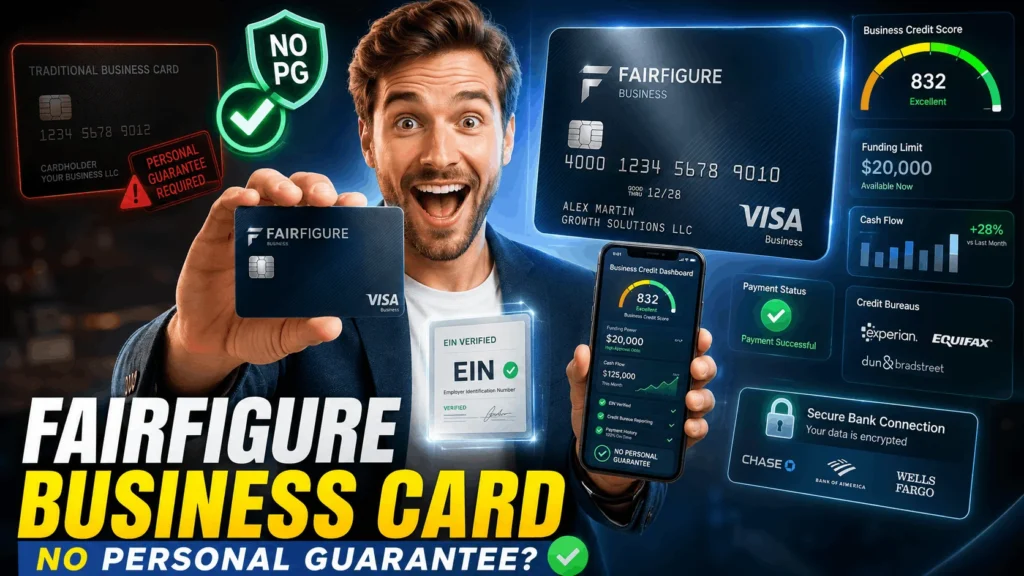
If you only have a minute, here’s the short version of this Fair Figure business credit card review. FairFigure gives you a no-personal-guarantee charge card funded by your business cash flow, bundled with credit monitoring across several bureaus, identity theft protection, and a dispute tool for incorrect data. It costs less than NAV’s comparable plan and reports more consistently than most starter vendor trade lines you’ll find online.
Where it comes up short is on rewards. This isn’t a card built for travel points or cashback, despite some marketing language that seems to hint otherwise. If you’re specifically after a rewards card, look elsewhere. But if your goal with this Fair Figure business credit card review was to figure out whether it actually helps build a real credit file, the answer leans firmly toward yes, and that alone makes the Fair Figure business credit card worth a serious look.
Fair Figure Capital Business Card: Key Features
The Fair Figure Capital business card isn’t a traditional revolving credit card, it works more like a corporate charge card, and that structure is exactly why the Fair Figure Capital business card keeps coming up in no-PG funding discussions. Once your Fair Figure Capital business card is approved, funds load onto either a physical or virtual card, and you choose a repayment term of four weeks or eight weeks (some sources describe this as net 30 or net 60). Picking the longer term means paying more in financing fees, so it’s worth doing the math before you decide.
Beyond the Fair Figure business credit card itself, FairFigure bundles in a business credit monitoring dashboard that pulls data from Dun & Bradstreet, Equifax Business, and CreditSafe, with Experian Business reportedly on the way. That’s a wider spread of bureaus than most competitors offer in a single subscription. You also get access to a tool called Credit Correct, which helps you dispute incorrect information on your business credit file, plus identity theft protection and a darknet scanner that flags if your company’s sensitive data shows up somewhere it shouldn’t.
FairFigure Capital Card Requirements
The FairFigure Capital Card requirements are refreshingly simple compared to a traditional bank line. Meeting the FairFigure Capital Card requirements starts with a business entity and an EIN, though sole proprietors using their business as identification can often still work through the process. There’s no minimum time in business required, and no personal credit check happens during the application. What actually matters is your business bank account activity, since that’s what the underwriting model relies on to set your funding amount.
That said, don’t confuse “no personal credit check” with “no requirements at all.” The Fair Figure business credit card still wants to see healthy cash flow. Negative days on your business checking accounts, meaning days where your balance dips into overdraft, can hurt your approval odds significantly, and that’s one of the FairFigure Capital Card requirements people overlook most often. If you’re serious about meeting FairFigure Capital Card requirements, keeping consistent deposits and avoiding NSF fees on your business account matters more than your personal FICO score ever will.
FairFigure Pricing: How Much Does It Cost?
The premium subscription for the Fair Figure business credit card runs about $25 to $35 a month depending on which source you check, with the credit monitoring tier commonly listed around $30 monthly. That fee itself gets reported as a separate vendor tradeline, so paying for the service actually contributes a small positive payment history entry to your business credit file, on top of whatever the Fair Figure business credit card itself reports.
There’s also a free account tier, but reviewers are fairly unanimous that it doesn’t offer much. The real value sits behind the premium plan, since that’s what unlocks the foundation score, the full bureau monitoring, and eligibility for the capital card. Compared to NAV, which charges anywhere from $49.99 to $59.99 a month for a similar premium tier and reports to only three bureaus, the Fair Figure business credit card comes in at close to half the price while covering more ground.
Growing Business Credit Builder: How FairFigure Helps You Boost Business Credit

FairFigure markets itself as a growing business credit builder, and the mechanics behind that claim are worth understanding. As a growing business credit builder, it leans almost entirely on consistent, on-time reporting rather than flashy perks, and that focus is exactly what separates a real growing business credit builder from a vendor account that quietly stops reporting. Every on-time payment on the Fair Figure business credit card gets reported to the bureaus that matter for funding.
This is exactly the kind of positive tradeline history lenders look for down the road when you apply for a bigger business credit card later. If your long-term goal is to boost business credit enough to qualify for larger no-PG lines from other lenders, having consistent, on-time reporting on your Fair Figure business credit card genuinely helps you boost business credit month over month and build that track record faster than most vendor tradelines would on their own.
As a growing business credit builder, where FairFigure stands apart from a lot of the starter vendor trade lines people chase online is transparency. A lot of those smaller trade lines quietly lose their data furnishing license or simply stop reporting, and you’d never know unless you checked. FairFigure’s dashboard shows you exactly what’s being reported and to which bureau, which makes it easier to boost existing commercial scores with confidence instead of guessing whether a vendor account is actually helping. Owners who already have some history and simply want to boost existing commercial scores tend to get the most out of the monitoring dashboard specifically, since it’s built to help you boost existing commercial scores without guesswork.
Who Should Use FairFigure? Startup Business Credit Cards With No Credit or EIN Only
If you’re specifically hunting for startup business credit cards with no credit history required, the Fair Figure business credit card is one of the more accessible entries in that category, and it’s a name that keeps showing up on lists of startup business credit cards with no credit checks attached, right alongside a handful of net 30 vendor options aimed at the same audience.
Since approval leans on your business bank activity rather than a personal credit pull, a brand-new business owner with thin or damaged personal credit can still get approved, as long as the business account itself shows healthy deposits. That’s a meaningful difference from most traditional small business cards, which almost always require a personal guarantee and a credit check up front, unlike most startup business credit cards with no credit history requirements built in.
It’s also worth being clear about who this card isn’t built for. If you want a rewards card for travel points or cash back, FairFigure openly admits that’s not the focus, the benefits revolve around credit building and funding access rather than perks. So if your business already has strong revenue and established credit, you might get more mileage out of a premium rewards card instead of an EIN-only credit builder like this one.
Best Business Credit Cards for Fair Credit: Where FairFigure Fits
Despite the name, “fair” here refers to the company, not a personal credit score tier, but it’s a fair question to ask whether this card works if your own credit history is less than perfect. Since there’s no personal credit check involved, FairFigure genuinely belongs on any list of the best business credit cards for fair credit or even bad personal credit, because approval hinges on your business’s cash flow rather than your FICO score. If your personal credit has taken some hits but your business banking looks healthy, this is one of the few realistic paths among the best business credit cards for fair credit that won’t ding your personal file.
That said, if you’re comparing the best business credit cards for fair credit more broadly, or even for owners who’d describe their own credit as rough right now, it helps to have a couple of alternatives in mind, since not every card marketed toward the best business credit cards for fair credit actually skips the personal guarantee. NAV Prime is the most obvious comparison point, though it offers fewer bureaus and less detailed reporting. Larger players like Brex and Divvy target businesses with more established revenue and generally still expect stronger financials, so they’re not always a fit for a brand-new EIN-only applicant the way FairFigure is.
Fair Figure Business Credit Card Pros and Cons
Pros:
- No personal guarantee and no personal credit check required
- Reports to Equifax Commercial, CreditSafe, and the SBFE, with Experian reportedly coming
- Roughly half the monthly cost of NAV’s premium tier
- Monthly subscription fee itself reports as an added tradeline
- Includes identity theft protection and a darknet scanner at no extra charge
- Funding decisions based on business cash flow, not personal FICO
Cons:
- Financing fees on the capital card can run higher than a traditional line of credit
- No cashback despite some marketing language that implies otherwise
- Currently no confirmed reporting to Dun & Bradstreet or Experian Business through the card itself
- Not a rewards card, so it won’t suit businesses chasing travel points
- Free tier offers very limited value compared to the paid plan
How Does FairFigure Compare to Competitors?
NAV remains the most common comparison for the Fair Figure business credit card, and it’s a fair one since both platforms monitor business credit across multiple bureaus. The difference comes down to depth and cost. FairFigure shows you the same underlying data that underwriters actually pull, including financial stability risk ratings, while NAV Prime tends to show a more generic, templated report. For roughly half the price, that’s a meaningful gap in value.
Compared to full financial platforms built for small business owners, like online banks for small business that bundle checking, cards, and bookkeeping together, the Fair Figure business credit card is narrower in scope. The Fair Figure business credit card isn’t trying to replace your bank account, it’s built specifically to build a credit file and connect you with funding.
If you’re a freelancer or solopreneur still deciding on an online bank account for freelancers to pair with a credit builder like this, keep in mind FairFigure needs a connected business checking account to work its underwriting model in the first place, so the two go hand in hand rather than competing with each other.
Best Credit Cards for Small Business: A Quick Look Beyond FairFigure

FairFigure isn’t the only name worth knowing if you’re building out your business credit stack. Among the best credit cards for small business, EIN-only options tend to fall into two camps: pure credit builders like FairFigure, and traditional issuer cards from banks like Capital One or Chase that still require a personal guarantee for most small business applicants. If your priority is avoiding a personal credit check entirely, your realistic options narrow quickly, and FairFigure is currently one of the more complete choices in that specific lane.
It’s also smart to layer in a couple of net 30 vendor accounts alongside any of the best credit cards for small business you apply for, since a mix of tradelines reporting consistently tends to build a stronger, more diverse credit file than relying on a single card alone. When people ask us to name the best credit cards for small business owners with no personal guarantee, FairFigure is almost always on that shortlist.
Frequently Asked Questions
Is FairFigure legit?
Yes, the Fair Figure business credit card comes from a registered company founded in 2021, and while it isn’t Better Business Bureau accredited, it holds an A- rating with minimal complaints. The founder has a background in multiple net 30 and business credit companies, which lends some credibility to the platform’s underwriting approach.
What are the top 5 business credit cards?
It depends on your goals, but common picks include the Fair Figure business credit card for no-PG funding, Capital One Spark Cash for cashback, Chase Ink Business for flexible rewards, Brex for tech-forward startups, and NAV Prime as a monitoring-focused alternative. The right pick depends on whether you value rewards, funding access, or credit building most.
How much does FairFigure cost?
The premium plan runs about $25 to $35 a month, commonly listed around $30. There’s a free tier too, though it offers minimal features compared to the paid version, which unlocks the full foundation score, bureau monitoring, and capital card eligibility.
What is a FairFigure credit card?
The Fair Figure business credit card is a business charge card tied to your company’s EIN rather than your personal Social Security number, meaning no personal guarantee or personal credit check. Funding amounts depend on your business bank account activity, and repayment terms run four or eight weeks, sometimes described as net 30 or net 60.
Can you withdraw money from a business credit card?
Generally no, not directly, since most business credit cards, including FairFigure’s, are designed for purchases rather than cash withdrawals. Some issuers offer a cash advance option with its own fees and terms, but that’s separate from standard spending and usually comes with a much higher cost.
What problems does FairFigure solve?
It solves the classic chicken-and-egg problem many small business owners face: needing credit to get funding, but needing funding history to boost business credit in the first place. By basing approval on cash flow instead of personal credit, it gives newer businesses and owners with damaged personal credit a realistic path to build a business credit profile.
How does FairFigure compare to competitors?
Compared to NAV, FairFigure reports to more bureaus for roughly half the monthly cost and shows the same underwriting data lenders actually use. Compared to traditional bank business cards, it skips the personal guarantee entirely, though it also skips the rewards and cashback those cards typically offer.
Which credit builder is best?
For EIN-only, no personal guarantee credit building specifically, FairFigure is one of the stronger options currently available, mostly due to its bureau coverage and lower monthly cost. If you don’t mind a personal credit check and want broader tradeline variety, pairing a monitoring tool like NAV with a handful of net 30 vendor accounts is still a valid strategy.
Does the Fair Figure business credit card affect my personal credit score?
No. Since approval and reporting are tied to your business EIN rather than your Social Security number, activity on the Fair Figure business credit card doesn’t show up on your personal credit report at all, which is one of the main reasons owners with less-than-perfect personal credit consider it.
Do I need good personal credit to qualify for FairFigure funding?
No. Approval is based on your business bank account activity and cash flow rather than your personal FICO score. That said, keeping your personal credit healthy still matters for other financing needs, like a mortgage or auto loan, even if it’s not a factor here.
Final Verdict
The Fair Figure business credit card earns its reputation among the no-PG crowd for good reason, and it’s easy to see why so many small business owners bring it up in the same breath as NAV. It reports to more bureaus than most comparable tools, costs less than its closest competitor, and gives newer business owners a genuine shot at funding without risking their personal credit. The Fair Figure business credit card isn’t going to replace a rewards card if that’s what you’re after, and the financing fees on longer repayment terms deserve a closer look before you commit.
If your main goal is building a real business credit file and getting access to funding without a personal guarantee, the Fair Figure business credit card is worth signing up for, especially at its current price point relative to NAV. Just go in with realistic expectations: it’s a credit-building tool first, and everything else is a bonus on top of that.