
Cold calling used to mean one thing: a rep with a headset, a long list of numbers, and a stack of rejections before lunch. That math has changed. Sales teams now turn to an AI voice agent for cold calling to place the first dial, qualify the lead, and hand a real conversation to a human closer only when it counts.
This guide compares the best AI voice agents for cold calling on the market right now, walks through what an AI cold calling bot actually does on a call, and breaks down which AI cold calling software fits which team size and budget. We also cover the FCC rule that changed AI cold calling software in 2026, so you don’t launch a campaign that gets you fined before it gets you a meeting.
What Is an AI Voice Agent for Cold Calling?
An AI voice agent for cold calling is a program that dials a prospect, talks with them in a natural back-and-forth, answers common objections, and either books a meeting or passes a qualified lead to a rep. It is not a robocaller and it is not an IVR tree. The best AI voice agents for cold calling sound close enough to a real person that most prospects never guess they’re on the phone with software.
That single AI voice agent for cold calling replaces the first, most repetitive dial on every list a team owns.
There are two broad categories worth knowing before you shop:
- Autonomous AI voice agents : no human on the line. The AI dials, pitches, qualifies, and books the meeting by itself. Retell AI, Bland AI, Vapi, Autocalls, and Synthflow all sit here.
- AI-assisted dialers : a human rep still talks, but AI removes the busywork around the call: parallel dialing, voicemail detection, live coaching, automatic notes. Orum, Nooks, Dialpad, and Kixie lead this group.
Both count as AI cold calling software in the broad sense, and plenty of teams run one of each at the same time.
Why Teams Choose an AI Voice Agent for Cold Calling in 2026
A single AI voice agent for cold calling can place 200 to 500 calls a day. A human SDR who dials manually reaches 50 to 80 on a good day. That gap alone rewrites the cost-per-meeting math once you add salary, benefits, and the weeks it takes a new hire to ramp.
Market research firms expect the voice AI agent category to grow at a steep clip through the early 2030s, and Gartner has forecast that conversational AI will cut contact center labor costs by roughly $80 billion globally by 2026, with a much higher share of agent interactions fully automated compared to just a few years ago. Whatever the exact figure lands on, the direction is clear: teams that skip a test of AI cold calling software fall behind the ones that don’t.
None of this means human reps disappear. The pattern that keeps repeating across real deployments is a split: AI takes the repetitive first dial, and reps spend the day on qualified conversations and closed deals instead of a cold list.
What to Check Before You Pick an AI Voice Agent for Cold Calling
Run through this list before you sign a contract for any AI voice agent for cold calling.
- Voice quality and speed. A pause of even half a second before the AI responds gives it away as a machine. Call the demo line yourself, act like a skeptical prospect, and see if it holds up.
- Human handoff. When a call gets complex, the platform must route it to a person fast, with full context carried over so the prospect never repeats themselves.
- Language coverage. If your list spans more than one country, you need native-sounding accents in each language, not a script read flat in translation.
- CRM sync. A call that doesn’t land in Salesforce or HubSpot might as well not have happened. Look for a two-way sync, not a one-time contact push.
- Real cost per minute. Several platforms advertise a cheap per-minute rate and then require you to bring your own keys for the language model, the voice engine, and the transcription layer. Add those before you compare prices.
Compliance tools. This got far more serious in January 2026 (see the next section).
AI Cold Calling Software in 2026: The Compliance Shift
Anyone who shops AI cold calling software in 2026 needs to know about the FCC’s One-to-One Consent Rule, live since January 27, 2026. Every seller now needs separate, written consent from each individual prospect before an AI voice or automated dialer can reach them. A purchased list where people once agreed to “hear from vendors” in general no longer covers automated or AI-assisted calls.
In practice, your AI voice agent for cold calling campaigns need consent tracked at the individual level, not the list level, and Do Not Call scrubbing has to run before every session, not just at import.
Consent tracking matters just as much for an AI voice agent for cold calling as it does for a fully human-dialed campaign, and it applies whether you buy ai cold calling software in 2026 or wait another year. No vendor manages your legal consent for you, that stays your job. Ask any provider exactly how their tool documents consent before you commit to a plan.
Top AI Voice Agents for Outbound Cold Calling Sales in 2026
Here are the top AI voice agents for outbound cold calling sales worth a real test call, ranked by what they do best rather than a single overall score. Each one below got tested with an actual phone call, not just a features-page read.
1. Retell AI
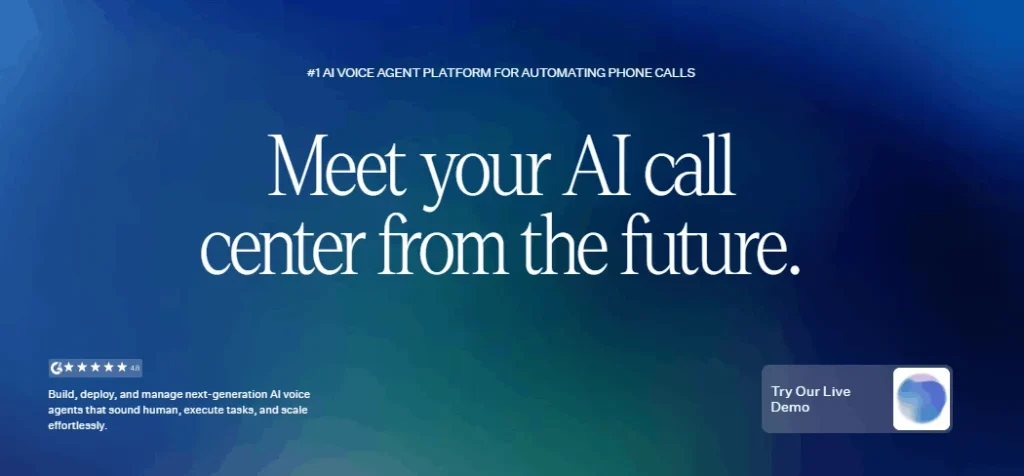
Retell AI is one of the first names people mention when they ask about the best AI voice agents for outbound cold calling 2026 has to offer, and it earns the spot. It supports over 55 languages with automatic detection live for ten of them, and it plugs natively into Salesforce, HubSpot, Shopify, and Cal.com.
What sets Retell apart is depth on the compliance and testing side. Teams run conversation regression tests and scenario checks without burning voice minutes, and a live dashboard tracks handoff rate, latency, sentiment, and turn accuracy. SOC 2 Type II, HIPAA certification, and PII redaction come standard, with no add-on fee for any of it.
Pros: wide language coverage, sub-second warm transfer with context, strong compliance built into every plan, open API plus native CRM links.
Cons: best suited to teams with some technical setup capacity, pricing needs a sales call rather than self-serve checkout.
Retell AI fits a mid-market or enterprise team that wants one AI voice agent for cold calling campaigns rather than three separate vendors stitched together, and it rarely fails the first-ten-seconds test that ends most other demos.
2. Bland AI
Bland AI takes a developer-first path. If your team has engineers who want custom conversation logic instead of a drag-and-drop builder, Bland gives you a strong API and real room to shape how each call behaves. It runs on a per-minute base fee plus a bring-your-own-keys model for the language model and voice provider.
The tradeoff: you get flexibility, but you also own the job of assembling and keeping the stack current. Batch calls work well, and control over conversation branches suits unusual workflows.
Its advantages include a flexible API, robust support for batch calls, and precise control over conversation branches. The downside is that it requires development resources; the “BYOK” (Bring Your Own Key) model drives the actual cost above the advertised price; and there is no visual builder for non-technical staff.
Bland AI belongs on any short list of the top AI voice agents for outbound cold calling sales, provided your team can read documentation and write a webhook handler.
3. Vapi

Vapi acts as a voice AI infrastructure layer rather than a finished product. You pick your own language model, your own text-to-speech engine, and your own transcription provider, and Vapi ties them together. Engineers who want full control over every stage of the pipeline like this setup a lot.
The catch is cost. The base platform fee reads cheap, but once you add a premium language model and studio-grade voice synthesis, the real per-minute rate climbs well past the number on the homepage. There is no built-in campaign dashboard either.
Pros: most flexible API on the market, active developer community, no lock-in on the underlying AI providers. Cons: not usable by non-technical teams, BYOK pricing hides the real cost, no native list or campaign management.
Vapi rewards a team that already runs its own AI voice agent for cold calling infrastructure and just wants raw building blocks, not a finished product. It’s a poor fit for anyone who wants an AI voice agent for cold calling up and running the same afternoon.
4. Autocalls
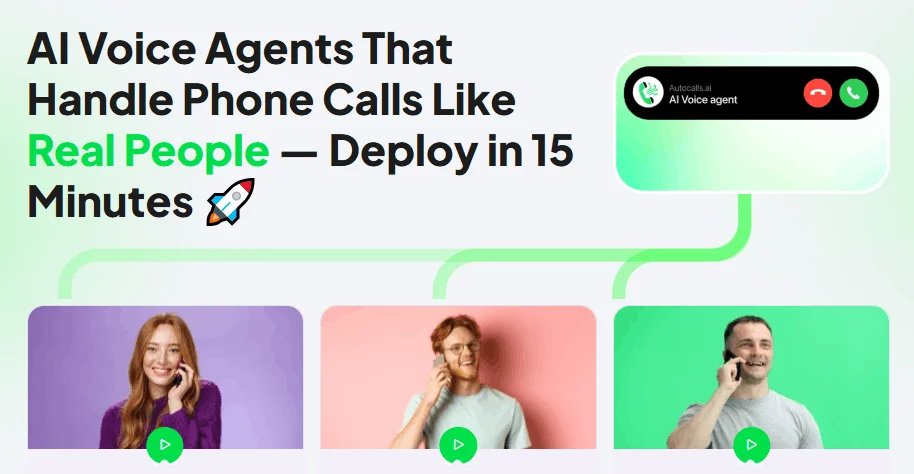
Autocalls stands out in most comparisons of AI cold calling software because of flat, all-inclusive pricing. Competitors charge a base rate and then bill separately for the language model, the voice engine, and transcription; Autocalls bundles the whole stack into one flat per-minute price. Full-duplex voice lets the agent take an interruption mid-sentence without the awkward stall that gives away a synthetic caller.
Beyond the core AI voice agent, Autocalls supports omnichannel follow-up : a call that doesn’t convert can trigger a WhatsApp or chat message on its own, and it offers full white-label options, a common draw for agencies that resell AI cold calling as a service. Setup is no-code and takes about fifteen minutes, with room for hundreds of concurrent calls on the higher tiers.
- Pros: all-inclusive pricing with no hidden BYOK costs, full-duplex voice, white-label for agencies, built-in omnichannel follow-up.
- Cons: no free trial (a demo call only), a younger platform than some enterprise names, best features sit on higher tiers.
Autocalls is one of the more affordable ways into an AI voice agent for cold calling right now, especially for an agency that wants to resell the service under its own name.
5. Synthflow
Synthflow keeps things simple. A solo founder or a small team that wants to try an AI voice agent for cold calling for the first time can learn the no-code pathway builder in an afternoon. It links with HubSpot and GoHighLevel out of the box.
The downside is the same BYOK trap that hits several tools here : the advertised starting price looks good until your own API keys get added, and the real per-minute cost lands closer to double or triple the budget you planned. Voice quality trails premium competitors, and there’s no channel beyond voice.
Pros: easy to learn fast, solid HubSpot and GoHighLevel links, white-label on higher tiers. Cons: BYOK inflates real cost, voice quality behind premium rivals, no SMS or chat follow-up.
Synthflow works well as a first AI voice agent for cold calling test before a team commits real budget to the category.
6. Air.ai
Air.ai targets high-volume enterprise campaigns and can carry a long conversation, reportedly up to forty minutes, which matters for a complex B2B pitch that a quick script can’t cover. It links to major CRMs and books meetings straight to a calendar without a human step in between.
Per-minute cost runs higher here than most of the field, and voice naturalness gets mixed reviews depending on the use case. It has also drawn some pushback for marketing claims that outran what testers actually heard on real calls, so test it yourself before you trust the sales page.
Pros: handles long, complex conversations, built-in calendar booking and CRM sync, enterprise-grade infrastructure. Cons: the highest per-minute price among the autonomous tools here, mixed feedback on voice naturalness, thin white-label options.
Air.ai fits a team that needs an AI voice agent for cold calling built for long, complex enterprise conversations rather than a quick first touch.
7. Commplify
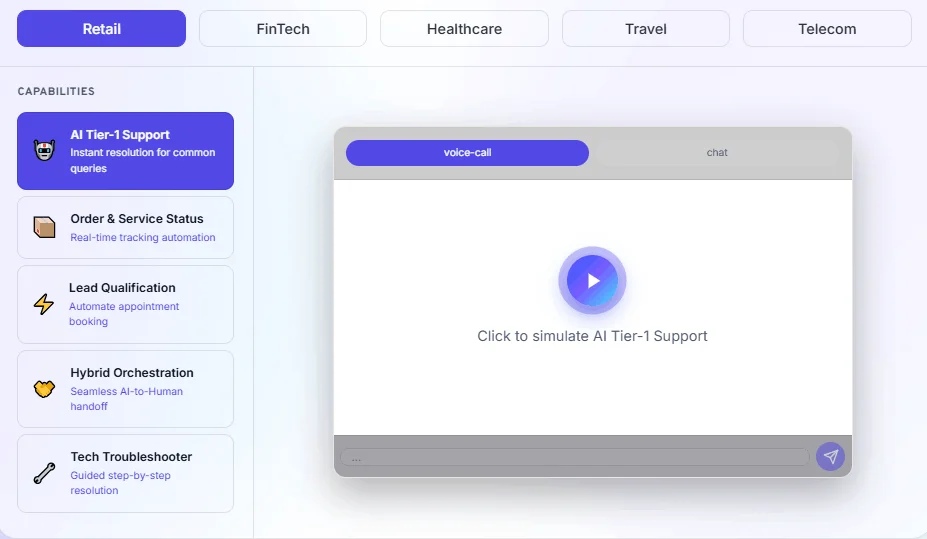
Commplify treats a cold call as one piece of a bigger picture. It manages voice, SMS, chat, email, and WhatsApp from one inbox, and a missed call can trigger a follow-up text within seconds through a no-code visual builder — a real plus for a revenue team that doesn’t want to file an engineering ticket for every tweak.
It fits B2B SaaS and healthcare teams especially well, where regulated follow-up and unified analytics matter as much as the first dial. A team that only wants a lean, voice-only AI voice agent for cold calling won’t use the full platform depth here.
Pros: true omnichannel reach in one inbox, no-code workflow builder, unified analytics across every channel. Cons: more platform than a voice-only team needs, best value depends on the full channel mix.
Commplify fits a team that wants its AI voice agent for cold calling to sit inside a bigger omnichannel workflow rather than run on its own.
8. CloudTalk
CloudTalk leans toward the AI-assisted side but now bundles a genuine autonomous AI voice agent add-on for first-touch qualification, on top of its long-standing power and parallel dialer. It offers local numbers across 160 countries (the broadest reach on this list) plus real-time sentiment analysis that flags a tone shift mid-call.
For a team that keeps a human SDR floor while it tests an AI voice agent for cold calling on the side, CloudTalk covers both under one roof. The AI Voice Agent add-on starts around $350 a month, so budget for it as a separate line rather than assume it’s bundled with the base seat price.
Pros: broadest international coverage, one platform for power dialing, parallel dialing, and an autonomous agent, transparent per-seat pricing. Cons: the AI Voice Agent add-on costs extra, some reviews flag call quality under peak load.
CloudTalk fits a team that wants one bill for both a human dialer and an AI voice agent for cold calling instead of two separate vendors.
Best AI Cold Calling Software Platforms Compared
| Platform | Type | Starting Price | Best For |
|---|---|---|---|
| Retell AI | Autonomous | Custom (sales call) | Mid-market and enterprise, strong compliance |
| Bland AI | Autonomous, developer-first | ~$0.09/min + BYOK | Engineering teams that build custom flows |
| Vapi | Autonomous, API-first | ~$0.05/min + BYOK | Maximum technical control |
| Autocalls | Autonomous, all-inclusive | $34/mo | Agencies, white-label, flat pricing |
| Synthflow | Autonomous, no-code | $29/mo + BYOK | Solo users, first-time tests |
| Air.ai | Autonomous, enterprise | ~$0.11/min | Long, complex B2B conversations |
| Commplify | Autonomous + omnichannel | Custom | B2B SaaS and healthcare teams |
| CloudTalk | AI-assisted + AI agent add-on | $25/user/mo | Teams that want a dialer and an AI agent together |
This table covers the best AI cold calling software platforms for autonomous calling. If your bottleneck sits with a human SDR floor instead, the next section covers the assisted side of AI cold calling software.
Best AI Telemarketing Software for Assisted Dialing
Not every team needs a fully autonomous AI voice agent for cold calling. If reps already work the phones and you just want them faster, the best AI telemarketing software gets most of the same gains without a change in model.
Orum posts one of the more credible connect rate benchmarks in the field, around 5.3% platform-wide, and its voicemail drop feature lifts pickup rates on the next call to the same number. Nooks pairs parallel dialing with a virtual sales floor that keeps a remote SDR team sharp through a long shift. Kixie built its name on a pool of over fifty thousand rotating numbers meant to dodge carrier spam flags.
Dialpad bakes real-time AI coaching straight into its phone system starting around $15 a seat, hard to beat for a team that wants coaching without a second tool. JustCall and Salesken round things out, JustCall for clear, published pricing, Salesken for objection coaching built from your own call history rather than a generic script.
If connect rate is the problem, look at Orum or Kixie. If coaching quality is the gap, Dialpad or Salesken. If team energy on a growing SDR floor matters most, Nooks. None of these seven count as a true AI cold calling bot in the autonomous sense, since a human stays on every call, but they’re worth knowing before you commit to replacing your floor entirely.
AI Cold Calling Role Play and AI Sales Call Practice
One use case that most comparisons skip: AI cold calling role play as a training tool. Sales managers now set up the same voice agent tech to simulate a call so a new rep can practice objection handling before they ever dial a real prospect.
AI sales call practice built this way lets a manager create a “difficult buyer” persona, run a rep through it dozens of times, and score the result against a rubric : no real lead spent. Some teams build an entire week of onboarding around this kind of role play, since a rep who fumbles a fake objection in private learns faster than one who fumbles it on a live prospect. It’s a smaller use case than full outbound automation, but it’s one of the more practical ways a team gets value from an AI cold calling bot without putting a real call at risk.
Agencies that build proposals and pricing right after an AI-booked meeting also lean on structured tools elsewhere in the funnel, a look at the Best Proposal Software for Accountants is worth it if your firm quotes scope right after each qualified call an AI agent hands off.
AI Cold Calling for Real Estate
Real estate ranks among the fastest adopters of AI cold calling for real estate, and the fit makes sense: expired listings, inbound leads that need a callback within minutes, and a cold buyer list that no agent wants to work by hand.
An AI sales call agent can check budget, timeline, and financing status before a call ever reaches a human agent, so agents spend the day on people who are ready to talk rather than numbers that go to voicemail. Local presence dialing matters even more here, since a buyer answers a number from their own area code far more often than an out-of-state one.
Real estate teams that adopt an AI voice agent for cold calling usually start with expired listings before they touch a colder buyer list. Brokerages that scale this way often run into a parallel problem: more closed deals mean more paperwork on the finance side. That’s where Inventory and Accounting Software for Small Business tends to enter the conversation for offices that also stock signage, staging inventory, or supplies alongside a growing deal pipeline.
Conversational AI and Agent-Assist for Sales Calls

Draw a clear line between two things people mix up constantly: a fully autonomous voice agent, and conversational AI and agent-assist for sales calls that supports a human still on the line. Agent-assist tools like Salesken and Dialpad’s coaching layer listen as the call happens, surface a battlecard the moment a competitor gets named, and flag a missed qualification question before the call even ends.
That’s a different product from an AI agent for sales calls that runs the whole conversation solo — and plenty of teams run both together, an autonomous agent for first-touch volume and agent-assist for the higher-stakes calls a rep already owns.
A quick way to tell the categories apart: conversational AI and agent-assist for sales calls always keeps a human on the line, while an autonomous AI agent for sales calls replaces that human for the first touch entirely. A team that needs pure volume picks the second path; a team that wants to sharpen an existing floor picks the first.
Either way, AI agents for sales calls change what a small team’s back office looks like once volume climbs. A founder who used to track every quote by hand often moves to something like Puzzle ai accounting software once an AI voice agent for cold calling starts to book more meetings than one person can invoice manually.
How to Pick the Right AI Voice Agent for Cold Calling Campaigns
Picking an AI voice agent for cold calling starts with an honest read of whether you need full autonomy or just a faster dialer for reps you already pay. A brand-new market with no sales floor yet gets more from an autonomous AI voice agent for cold calling campaigns, since it adds volume with no hiring cycle. A team with five or more SDRs already on the phones likely gets more value per dollar from an assisted dialer like Orum or Nooks.
A rushed choice here costs more in wasted minutes than the monthly fee ever does, so work out the real cost before you sign, not after.
Next, work out the real cost per minute rather than the advertised one. Any platform on a bring-your-own-keys model needs the language model, voice engine, and transcription costs added before you compare it to an all-inclusive option — the gap between sticker price and real bill can run three or four times larger than the pricing page suggests.
Once volume grows past what one person tracks by hand, revenue teams often add a layer of account audit software to keep the books straight against every call outcome an AI voice agent logs.
Last step: call the demo line yourself. Act like a skeptical prospect, cut the agent off mid-sentence, and see how it recovers. No feature list matters if the voice doesn’t survive the first ten seconds of a real call.
Frequently Asked Questions About an AI Voice Agent for Cold Calling
Can AI agents cold call?
Yes. A modern AI voice agent for cold calling can dial a number, hold a natural back-and-forth, handle common objections, and book a meeting with no human on the line. The tech has moved well past the flat robocallers of a few years back, the best AI voice agents for cold calling now use full-duplex processing to take an interruption the way a real person would.
Which AI calling agent is the best?
It depends on the job. Retell AI stands out for a mid-market or enterprise team that wants compliance depth and wide language coverage. Autocalls leads on flat, all-inclusive pricing and agency white-label. A team that already runs SDRs likely gets more from an assisted dialer like Orum or Nooks than from a switch to a fully autonomous agent.
Is there an AI agent that can make phone calls?
Yes, Retell AI, Bland AI, Vapi, Autocalls, and Synthflow are all built to place outbound calls on their own, dial a list, and hold a full conversation with whoever picks up. Any one of them works as an ai sales call agent without a human on the line.
Which AI is best for calling?
For fully autonomous work, Retell AI and Autocalls rank among the top picks in most 2026 comparisons. For a team that wants AI to support a human rep rather than replace the call outright, Dialpad and Salesken lead on real-time coaching.
Is AI cold calling legal in 2026?
Yes, with conditions. The FCC’s One-to-One Consent Rule, live since January 27, 2026, requires separate, explicit consent before an AI voice or automated dialer reaches a consumer. B2B calls to business lines face fewer limits but still need Do Not Call compliance. Check your specific obligations with legal counsel before a campaign goes live.
What’s the difference between an AI dialer and an AI voice agent?
A dialer speeds up a human rep — parallel dialing, voicemail detection, automatic notes, but a person still talks on every call. An AI voice agent for cold calling runs the whole conversation on its own, from hello to a booked meeting, with no human involved until a lead needs a closer.
How much does an AI voice agent for cold calling cost?
Prices vary a lot. Entry-level autonomous tools start around $29 to $34 a month for a small block of minutes, while per-minute rates on developer-first platforms run $0.05 to $0.11 before bring-your-own-key costs. Assisted dialers for an existing SDR team typically run $15 to $400 per seat a month based on features.
The Bottom Line
The best AI voice agent for cold calling in 2026 isn’t the one with the flashiest demo, it’s the one that matches your actual bottleneck. Connect rate problems call for spam prevention and parallel dialing. Coaching gaps call for real-time assist.
A team that needs volume with no hiring cycle gets there fastest with an autonomous AI cold calling bot like Retell AI or Autocalls. Whichever way you go, test the voice yourself, check the real per-minute cost before you sign, and lock down consent tracking before the first dial goes out. Treat that first call like a real prospect call, because that’s exactly the experience you’re buying, an AI voice agent for cold calling is only as good as its first ten seconds.