
A broker with no CRM runs on spreadsheets, group chats, and hope. That works for about a month. Once you have real clients, deposits, KYC files, and a partner network, you need a system built for the job — and that system is the best CRM for forex trading, not a generic sales tool bolted onto a trading desk. Migration risk is the hidden cost that rarely factors into a first pass at picking the best CRM for forex trading. A cheaper platform that fits your workflow beats a pricier one marketed as the best CRM for forex trading in general.
This guide compares the top forex CRM providers on the market right now, walks through the features that actually matter, and helps you pick the best CRM for forex trading based on your brokerage stage — whether you’re launching next month or already running a multi-brand operation with hundreds of active traders. Migrating to a new crm system for forex trading mid-operation is costly, so get the decision right the first time. Weigh implementation timeline heavily — the best CRM for forex trading on paper is worthless if it takes six months to go live.
What Is a CRM in Forex Trading?
A CRM in forex trading is a platform built specifically to run the full client lifecycle at a brokerage: lead capture, KYC and AML checks, trading account creation, deposits and withdrawals, IB commission tracking, and compliance reporting, all synced with your trading platform in real time. It’s the operational backbone that sits between your marketing funnel and your trading infrastructure. Most brokers choose CRM for forex trading based on price first and regret it once compliance requirements grow.
Generic tools like Salesforce or HubSpot were never built for this. They can log a contact and send an email sequence, but they have no idea what an MT4 account balance is, can’t calculate a three-tier IB commission, and won’t flag a client for AML review. That gap is exactly why a dedicated crm system for forex trading exists as its own software category, separate from general business CRM. A solid crm for trading operations should never require a spreadsheet to reconcile IB commissions manually.
A quick way to picture it: imagine onboarding a new client. The best CRM for forex trading prompts KYC verification, opens a trading account on MT4 or MT5 through the platform’s API, links a payment method through the client portal, tracks the client’s trading behavior, and drops that client into the right lifecycle segment — all without a human touching a spreadsheet. Price transparency is one small signal of the best CRM for forex trading, but it’s far from the only one that matters.
You May Read Also About Software
- Best AI Voice Agent for Cold Calling in 2026: 10 Platforms Compared
- What Is an API for Tracking Price Changes Across E-Commerce Platforms?
- Common Account Audit Software Used in Kenya (2026 Comparison)
- Best Proposal Software for Accountants (2026 Comparison)
- Puzzle.io Reviews: The Full 2026 Breakdown (Features, Pricing, Pros & Cons)
- Sage Accounting vs QuickBooks: Which Accounting Software Should You Choose?
- Accounting Software Implementation Best Practices: The Complete Guide for Small Business
- Inventory and Accounting Software for Small Business:
Why Generic CRM Software Falls Short for Brokers
Some new brokers try Salesforce, Zoho, or HubSpot first, since they’re familiar names. The problem shows up fast. These platforms have no native trading platform integration, so every deposit or trade event needs custom middleware that breaks under real volume. They have no multi-tier IB logic built in, no forex-specific KYC and AML workflows, and no multi-currency wallet handling. Some Forex CRM Solutions for Brokers charge per active client rather than per staff seat, so read the pricing page closely.
Research from McKinsey found that employees working across poorly connected systems spend roughly 30 to 40% of their time just searching for data, and another 20 to 30% cleaning it up once found — overhead that directly threatens compliance and revenue at a regulated brokerage. That’s the real cost of forcing a generic tool to act like a forex CRM software for brokers platform.
Purpose-built systems remove that friction from day one, since the trading account, not the contact card, is the object the whole system is built around — which is the core reason the best CRM for forex trading always starts from brokerage workflows, not a generic sales template. The right crm solutions for forex trading business fit depends more on your IB structure than your headcount.
What to Look For: Forex CRM Features That Actually Matter
- Not every forex trading crm features list matters equally. Here’s what separates a broker-ready platform from a repurposed sales tool. Several Forex CRM providers now bundle compliance tooling for free rather than charging it as a separate line item.
- Native trading platform integration. Your CRM must sync in real time with MT4, MT5, cTrader, or whichever engine you run. Ask any vendor exactly how fast that sync happens and whether it supports multiple servers at once. A forex broker crm for crypto trading setup only works well if liquidity and settlement connect cleanly to the wallet layer.
- KYC and AML automation. Client onboarding speed directly affects conversion — every extra hour someone waits for approval is an hour they might sign up somewhere else instead. Look for automated document verification through providers like SumSub, Shufti Pro, or Onfido, plus a full audit trail. A platform can be the best CRM for forex trading for compliance and still lag on IB automation, so weigh your own priorities first.
- IB and partner management. Introducing brokers drive a large share of client acquisition at most firms, so your CRM needs unlimited multi-tier commission structures, automated rebate math, and a dedicated partner portal, not just basic referral tracking. A shortlist built from real demos, not marketing pages, is still the fastest way to land on the best CRM for forex trading for your team. Pull up your actual IB tree before you decide which platform is the best CRM for forex trading for your partner network.
- Payment gateway breadth. Clients expect to fund accounts with their local payment method. A CRM that only connects to a handful of PSPs limits which regions you can actually serve. The core forex trading crm features rarely change between vendors — it’s the execution quality that differs.
- Reporting and analytics. Real-time dashboards for P&L, client acquisition, and partner performance — with export to Excel or CSV — should come standard, not as a paid add-on. The best CRM for forex trading often turns out to be the one with the most boring, reliable KYC workflow, not the flashiest dashboard. A lightweight crm for trading can still cover onboarding, KYC, and basic reporting for a small team.
- Compliance and data security. ISO 27001 certification is the closest thing to a gold standard here, since it means annual independent audits of the provider’s security practices. Role-based access, encryption, and full audit logs matter just as much. When you choose CRM for forex trading software, weigh integration depth well above interface design.
- Deployment speed. A well-built platform should go live within one to two weeks for a standard setup. If a vendor quotes months, that usually points to a legacy system or a team without much implementation experience. The forex trading crm features that get the least marketing attention are often the ones compliance teams rely on most. A CRM that wins on price but fails on compliance was never really the best CRM for forex trading for a regulated brokerage.
Forex Trading CRM Features Ranked by Importance
Not every provider weighs each feature the same way, but when you line up the forex trading crm features that show up across every serious platform, a clear hierarchy emerges. Trading-platform sync and KYC automation top the list because they touch every single client. IB and partner management comes next, since it drives acquisition at most brokerages.
Payment breadth, reporting depth, and compliance certification round out the list — all important, but secondary to getting the first two rock solid. Keep that order in mind when a vendor tries to sell you on a flashy dashboard before confirming their MT4 sync actually works under real trading volume. The best CRM for forex trading for a five-person startup looks nothing like the best CRM for forex trading for a 50-person enterprise desk.
Forex CRM Software for Brokers: Quick Comparison
| Provider | Trading Platform Coverage | Key Strength | Best For | Starting Price |
|---|---|---|---|---|
| B2Core | MT4/MT5, cTrader, B2TRADER | Forex + crypto in one system | Multi-asset brokers | ~$2,500/mo |
| UpTrader | MT4/MT5, any platform in ~1 day | Flexibility, social trading | Growing brokerages | ~$1,500/mo |
| FXBO | MT4/MT5, cTrader, 370+ integrations | Scalability | Established brokers | ~$2,200/mo |
| Syntellicore | MT4/MT5, cTrader, MatchTrader, VertexFX | Tier-1 compliance | Regulated brokers | ~$2,000/mo |
| FYNXT | Multi-platform, low-code | Fast, modular deployment | Every growth stage | Custom |
| AltimaCRM | MT4/MT5, cTrader, Match-Trader | Omnichannel comms + KYC | Sales-led brokerages | Custom |
| TradeCore | MT4/MT5, cTrader, DXtrade, MatchTrader | All-in-one broker OS | High-automation teams | Custom |
| Panda Forex CRM | MT4/MT5 + 300+ integrations | Full operational hub | Scaling brokers | Custom |
| Brokeret | MT4/MT5, cTrader, MatchTrader | Budget-friendly, fast setup | Startup brokers | ~$1,000/mo |
| LXCRM (Leverate) | MT4/MT5, Sirix | Leverate ecosystem fit | Leverate clients | ~$3,000/mo |
Prices are approximate and vary by feature set, contract length, and customization.
CRMs for Forex Brokers: Five Platform Types to Know
Before you compare individual vendors, it helps to know that CRMs for forex brokers actually split into five distinct types, and each one fits a different brokerage profile. Knowing your type first saves a lot of wasted demo calls. It takes real diligence to choose CRM for forex trading software that still fits two years from now. Vendors change their pricing often, so revisit the best CRM for forex trading question every renewal cycle, not just at launch.
Packaged SaaS CRM: Pre-built modules, a client portal, basic IB management, and tiered pricing you can plan around. This is the fastest route to launch and the right starting point for most new or growing brokers. Brokers switching platforms almost always say the same thing: they wish they’d tested the best CRM for forex trading candidates harder before signing. Reference clients in your own jurisdiction tell you more about the best CRM for forex trading than any case study page.
White-label CRM: A branded Trader’s Room bundled with deep IB and affiliate management, plus social trading modules. Brokers building a serious partner network usually land here once a packaged plan starts to feel tight. Not every Forex CRM Software for Brokers vendor publishes real pricing, which makes side-by-side comparison harder than it should be.
Enterprise automation CRM: Hundreds of integrations, ISO-certified infrastructure, omnichannel communication, and AI-assisted KYC. Built for high-volume brokers who need operational depth over simplicity. There’s no shortcut to finding the best CRM for forex trading beyond testing real onboarding, real commissions, and real reporting.
Integrated platform CRM: CRM bundled with a proprietary trading platform from a single vendor, so you get one dashboard instead of stitching a CRM to a separate trading engine. Compliance officers and sales managers rarely agree on what makes the best CRM for forex trading, so get both in the room during evaluation. Rank forex trading crm features by how many clients they touch, not by how impressive they look in a demo.
Custom-built CRM: Bespoke development with deep MT4 or MT5 integration for brokers whose workflows go beyond what any packaged platform can support. This is the slowest and most expensive route, but the only one that removes every constraint of off-the-shelf software. A checklist of Forex CRM Features is only useful if you test each one against your actual client volume. Brokers rarely regret spending an extra week on due diligence before settling on the best CRM for forex trading for their team.
Matching your brokerage to the right type before you start comparing the best CRM for forex trading by name. This will save you from paying for enterprise complexity you don’t need yet, or getting boxed in by a starter plan you’ll outgrow in a year. A brokerage that outgrows its platform in a year didn’t actually pick the best CRM for forex trading — it picked the cheapest one. Scaling crm solutions for forex trading business operations usually means adding PSP coverage before anything else.
Best CRM for Forex Trading: Top Providers Reviewed
Here’s a closer look at the platforms worth putting on your shortlist for the best CRM for forex trading, with what each one does well and where it falls short. Pricing across CRMs for Forex Brokers varies more by feature depth than by brand name. Some Forex CRM Features look impressive in a demo but add little real value once a brokerage is live.
1. B2Core
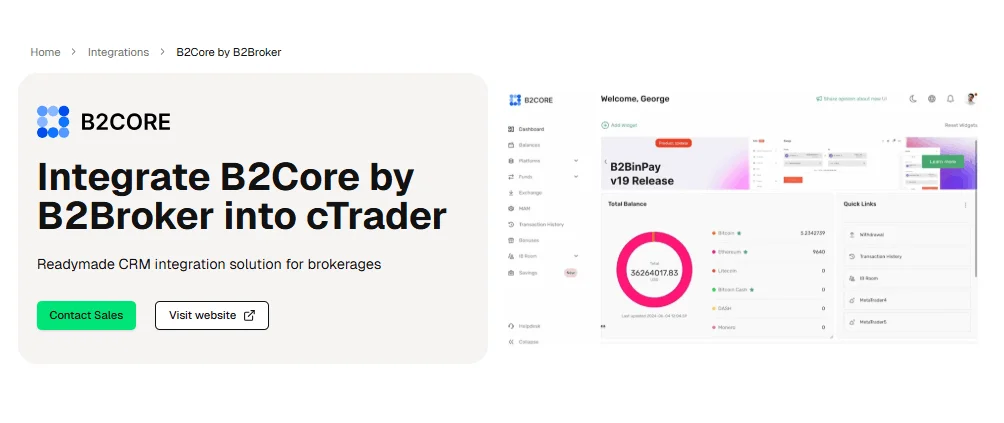
B2Core, built by B2Broker, is one of the strongest picks if your brokerage touches both traditional forex and crypto. Rather than running two separate systems for two asset classes, B2Core folds everything into one platform — client cabinet, back office, and multi-currency wallets that handle fiat and digital assets side by side.
It connects natively to MT4, MT5, cTrader, and B2Broker’s own B2TRADER engine, and its IB module supports up to 30 tiers of partner hierarchy, which is deep even by enterprise standards. Payment-related Forex CRM Features directly affect deposit conversion, so don’t treat them as an afterthought. The best CRM for forex trading for a startup rarely stays the best CRM for forex trading once that startup becomes an enterprise brokerage.
For a broker already inside the B2Broker ecosystem, or one planning to add cryptocurrency exchange platforms alongside standard FX pairs, B2Core removes the need to stitch two vendors together. The KYC and AML tooling comes built in rather than bolted on, and the back-office layer handles financial reporting without a second piece of software. Vendors love to list forex trading crm features on a website, but only a live test proves they work at scale.
Pros: unified forex and crypto wallets, deep IB hierarchy (up to 30 tiers), strong B2Broker ecosystem fit, solid compliance tooling. Cons: higher price tier (around $2,500/month and up), longer implementation than lighter platforms, can feel like more system than a small startup needs.
B2Core earns its spot near the top of any best forex CRM software shortlist specifically because of that multi-asset design, few competitors handle crypto and forex this cleanly in one interface. Picking the wrong Forex CRM for Your Brokerage early on almost always means a painful migration later.
2. UpTrader
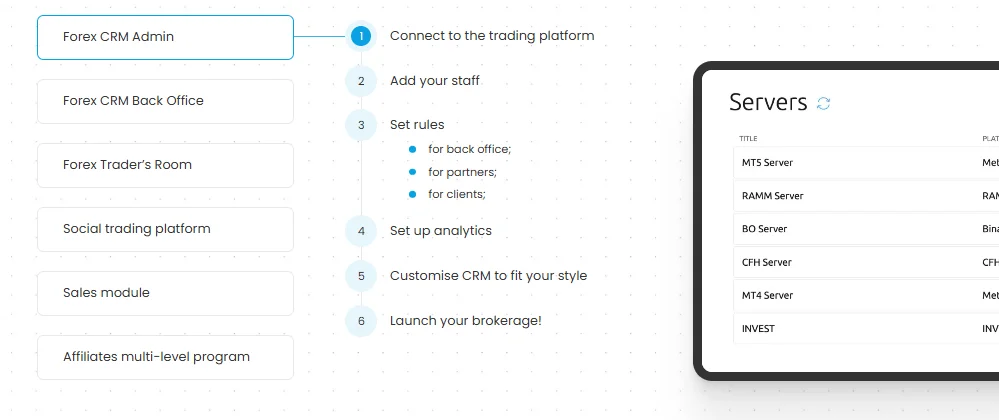
UpTrader built its reputation on flexibility. The platform claims it can integrate with almost any trading platform in about a day, which is a real advantage if you run something less common than MT4 or MT5. Beyond speed, UpTrader covers lead management, white-label branding, social trading support, and a full back office, all on cloud infrastructure so you’re not managing your own servers. Ask for a written SLA before you assume any vendor is really the best CRM for forex trading for a regulated operation.
Pricing sits in the mid-range, and the modular structure means a newer brokerage can start lean and add components — copy trading, extra IB tiers, custom dashboards — as the client base grows. That makes UpTrader a common recommendation for brokers past the very first launch phase but not yet at enterprise scale. Newer Forex CRM providers tend to compete hardest on price, while established Forex CRM providers compete on integration depth.
Pros: fast platform integration (about one day), strong social trading support, flexible pricing structure, cloud-based with no server management. Cons: larger brokerages often need more customization than the modular tiers offer, support quality varies by region.
If speed of setup matters more than deep customization, UpTrader is one of the better forex CRM providers to test first. Test a crm for trading with a real client record before you trust it with your full book.
3. FXBO (FX Back Office)
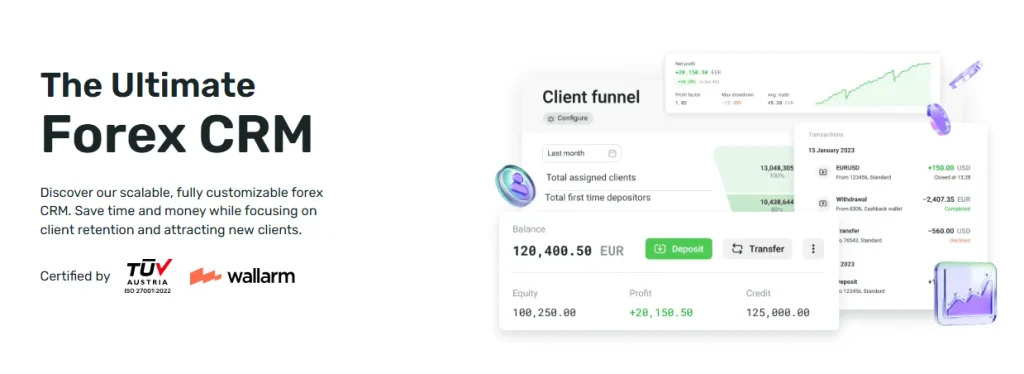
FXBO has been in the market since 2007, and that track record shows in its integration count — north of 370 connections across payment processors, trading platforms, and compliance tools. The Back Office module, branded Client Area, Partner/IB Area, and integrated Service Desk cover most of what a mid-size to large brokerage needs without extra vendors. Reference calls with existing clients remain the single best way to confirm a vendor really is the best CRM for forex trading for your case.
FXBO’s real strength is scale. It grows from a small operation into a full enterprise setup without forcing a platform switch, and its 340+ payment provider list means very few brokers will hit a wall on regional payment coverage. The tradeoff is that this breadth adds setup complexity — expect a longer onboarding process than a lighter tool like Brokeret.
The best CRM for forex trading conversation should always start with your own operational bottleneck, not a vendor’s feature list. Vendor demos are polished by design, so the best CRM for forex trading only reveals itself once you push past the sales pitch.
Pros: 370+ integrations, deep payment provider coverage, mature platform with 15+ years in the market, strong Partner/IB Area. Cons: longer implementation timeline, can be more than a very small team needs at first, custom pricing requires a sales call.
Established brokers looking for one of the most battle-tested forex CRM solutions for brokers tend to land on FXBO once they outgrow a simpler starter platform. A well-built crm system for forex trading should never force your compliance team to chase data across three tools.
4. Syntellicore (Dynamic Works)

Syntellicore leads on regulatory depth. Its AI-based KYC and AML verification completes in roughly 30 to 60 seconds, and it comes with built-in MiFIR and EMIR reporting — a real advantage for brokers under CySEC, FCA, or similar Tier-1 oversight.
RebateCore, its dedicated rebate engine, automates partner compensation without manual spreadsheets, and the Trader’s Room ships with a native mobile app on iOS and Android. Not all Forex CRM providers disclose their real implementation timeline until after the contract is signed. The best CRM for forex trading debate usually comes down to two or three finalists, not a single obvious winner.
Trading-platform connectivity covers MT4, MT5, cTrader, MatchTrader, and VertexFX, plus PAMM and prop trading modules for brokers running those models. Voice analysis for compliance on recorded calls is a feature few competitors offer at all, which explains why regulated, multi-jurisdiction brokerages gravitate toward it. Weigh total cost of ownership, not sticker price, when you compare candidates for the best CRM for forex trading.
Pros: fast AI-driven KYC/AML, strong MiFIR/EMIR compliance tooling, native mobile Trader’s Room, voice-call compliance monitoring. Cons: feature depth means a steeper learning curve, better suited to regulated operations than the smallest startups.
For a Tier-1 regulated brokerage, Syntellicore is arguably the best CRM for forex trading once audit depth outweighs deployment speed as the top priority. Compare Forex CRM Solutions for Brokers on total cost of ownership, not just the advertised monthly rate.
5. FYNXT
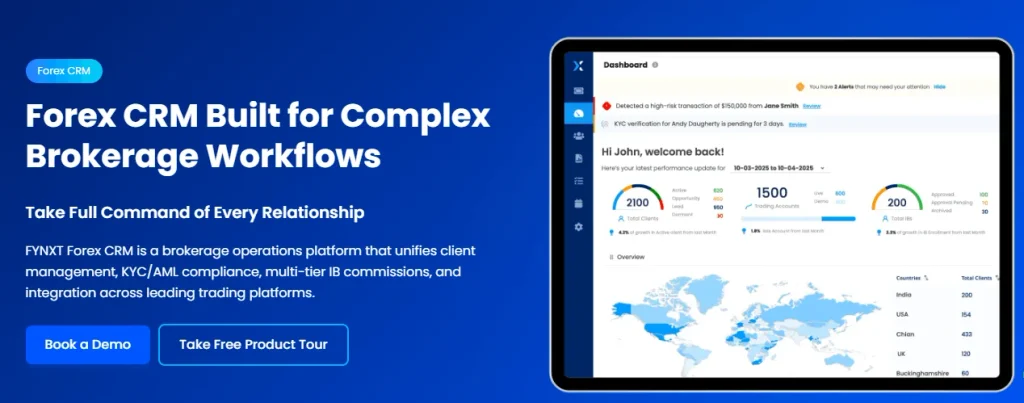
FYNXT, based in Singapore, takes a low-code approach that lets a broker adjust workflows without a development team on staff. Deployment runs on a standard two-week timeline, and the platform holds ISO 27001:2013 certification — independently verified, not just self-reported. Named clients including CMC Markets, Axi, and Exinity give it real enterprise credibility beyond marketing copy. Good Forex CRM Software for Brokers treats the trading account, not the contact record, as the central object it manages.
What makes FYNXT stand out on a forex CRM solutions for brokers shortlist is that it fits every stage of growth on the same modular architecture. A startup goes live in two weeks with core KYC and MT4/MT5 connectivity; a growth-stage broker adds IB automation and PSP coverage without re-platforming; an enterprise operation layers in multi-brand support and deeper compliance workflows on that same foundation. Demand a working sandbox from any Forex CRM Software for Brokers vendor before you sign a multi-year contract.
Pros: ISO 27001 certified, standard two-week deployment, low-code customization, scales from startup to enterprise without a platform switch. Cons: the breadth of modules can feel like overkill for a one-person operation testing the waters.
6. AltimaCRM
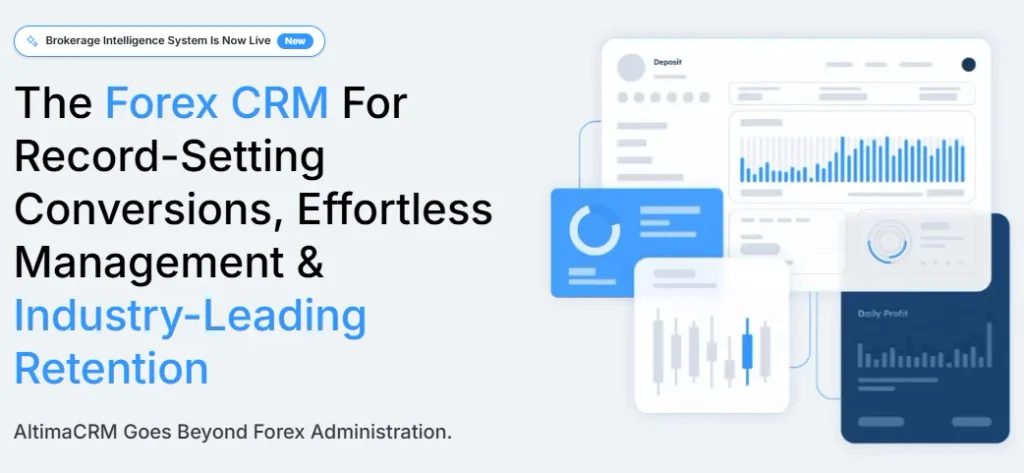
AltimaCRM centers its pitch on communication and compliance. It bundles VoIP, chat, SMS, and email into one omnichannel layer through its AltimaVoIP product, so sales and support teams work from a single interface instead of three separate tools. On the compliance side, it lists native KYC integrations with Shufti Pro, Sumsub, and Refinitiv, plus AI-powered verification and audit trails aligned with GDPR and PCI DSS.
A shortlist built from real deployments beats a Best Forex CRM Software ranking pulled straight from a vendor’s homepage. The best CRM for forex trading rarely announces itself with the flashiest onboarding video — test the actual workflow instead.
With over 50 active brokerages and more than 1.2 million leads managed through the platform, AltimaCRM has real production scale behind it. It connects to MT4, MT5, cTrader, and Match-Trader, and its multi-tier IB platform covers the partner side too. A demo call is the fastest way to tell whether a platform is really the right Forex CRM for Your Brokerage. A platform earns the label best CRM for forex trading through uptime and support tickets resolved, not through a homepage claim.
Pros: strong omnichannel communication built in, wide KYC provider support, proven scale (50+ brokerages, 1.2M+ leads), GDPR and PCI DSS-aligned workflows. Cons: communications-first design means some brokers may want deeper trading-side analytics than the default dashboards show.
Sales-led brokerages that live on the phone and in chat with clients often call AltimaCRM the best CRM for forex trading for their specific workflow. A brokerage should revisit its crm solutions for forex trading business choice every couple of years as volume grows.
7. TradeCore
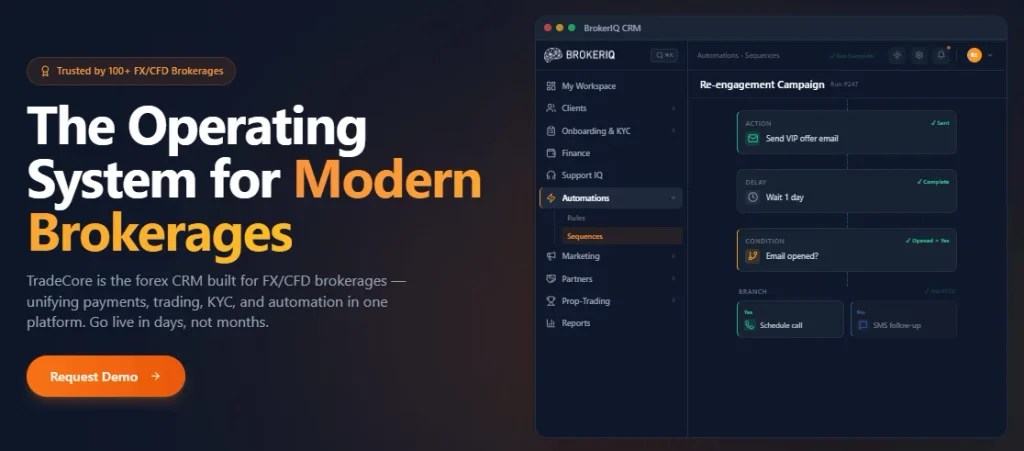
TradeCore positions itself less as a CRM and more as a full broker operating system — CRM, payments, KYC/AML, trading integrations, IB management, and prop trading infrastructure in one place. It supports 200+ integrations including MT4, MT5, cTrader, DXtrade, and MatchTrader, plus 100+ PSPs and 300+ payment methods. Choosing a crm for trading is really about choosing how your whole client lifecycle will run for the next few years.
The automation engine is a standout: 200+ workflow triggers and 100+ automated actions, backed by AI-assisted logic that cuts manual operational work significantly. TradeCore also markets fast deployment — new brands live in days rather than months — which appeals to brokers launching multiple entities under one group.
Speed to launch matters, but it shouldn’t be the only factor that decides the best CRM for forex trading for a new brokerage. The best CRM for forex trading for an offshore broker looks different from the best CRM for forex trading for an FCA-regulated desk.
Pros: genuinely unified operating system (CRM + payments + prop trading in one), large integration and PSP footprint, powerful automation engine, fast multi-brand deployment. Cons: custom pricing only, the sheer feature set takes time to configure properly.
For a group running several brands off one back end, TradeCore is a strong candidate for the best CRM for forex trading at that scale. The best crm system for forex trading choice usually comes down to integration depth over interface polish.
8. Panda Forex CRM (PandaTS)
Backed by more than 20 years of brokerage technology experience, PandaTS has helped launch over 400 brokerages and built an ecosystem with 300+ integrations across trading platforms, payment providers, KYC services, and communication tools. Unlike CRMs that focus mainly on lead management, Panda Forex CRM acts as the true operational center — sales, compliance, finance, and support teams all work inside the same environment against live trading data.
Take your time to choose CRM for forex trading tools, since the switching cost later is steep. Two brokers in the same country can land on a different best CRM for forex trading answer once IB structure enters the picture.
It integrates with the broader PandaTS stack too, including WebTrader, mobile trading apps, and its own IB Portal, so brokers already inside that ecosystem get tighter connectivity than a bolt-on CRM could offer. Enterprise-grade Forex CRM Solutions for Brokers usually justify their higher price with deeper compliance automation. Sales teams and compliance teams often disagree on the best CRM for forex trading, so score both perspectives before you sign.
Pros: two decades of brokerage-specific experience, 400+ brokerages launched, extensive PandaTS ecosystem integration, strong operational visibility across departments. Cons: custom pricing requires a sales conversation, deep ecosystem fit is less useful if you’re not on PandaTS infrastructure elsewhere.
Brokers that want one operational hub rather than a lead-management tool with extras bolted on tend to rate Panda among the best CRM for forex trading options available today. The best CRM for forex trading for a crypto-forex hybrid desk looks different from the best CRM for forex trading for a pure FX shop.
9. Brokeret
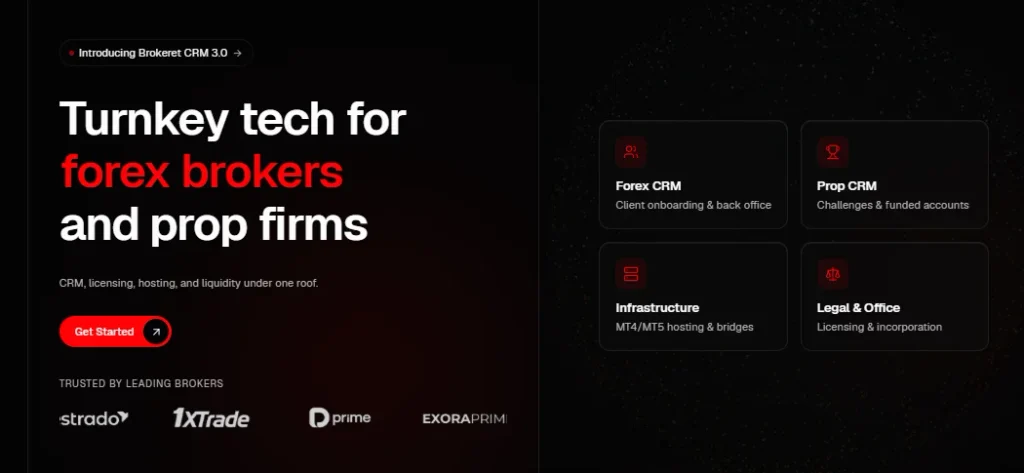
Brokeret is the newer name on this list, but it’s earned a strong reputation fast among startup and growing brokerages that want a clean, modern interface without enterprise pricing. It connects natively to MT4, MT5, cTrader, and MatchTrader, handles multi-tier IB commissions, and ships with KYC automation and payment gateway integration out of the box.
Treat any list claiming to name the single Best Forex CRM Software with some skepticism until you’ve tested it yourself. Data migration difficulty is worth asking about upfront, since it shapes how easily you can leave even the best CRM for forex trading later. A platform’s integration list is a starting point, not proof it’s the best CRM for forex trading for your trading platform mix.
Implementation typically runs one to two weeks, and the pricing — around $1,000 a month — makes it one of the more accessible entries on this list. For a brokerage that wants a complete crm for trading setup without a six-figure enterprise contract, Brokeret is worth a demo early in the shortlisting process. The market for Forex CRM Software for Brokers has matured fast over the past few years as regulation has tightened.
Pros: competitive pricing (~$1,000/month), fast implementation, modern and intuitive interface, responsive support. Cons: newer player with a shorter market track record, some advanced features are still in active development.
10. LXCRM (Leverate)
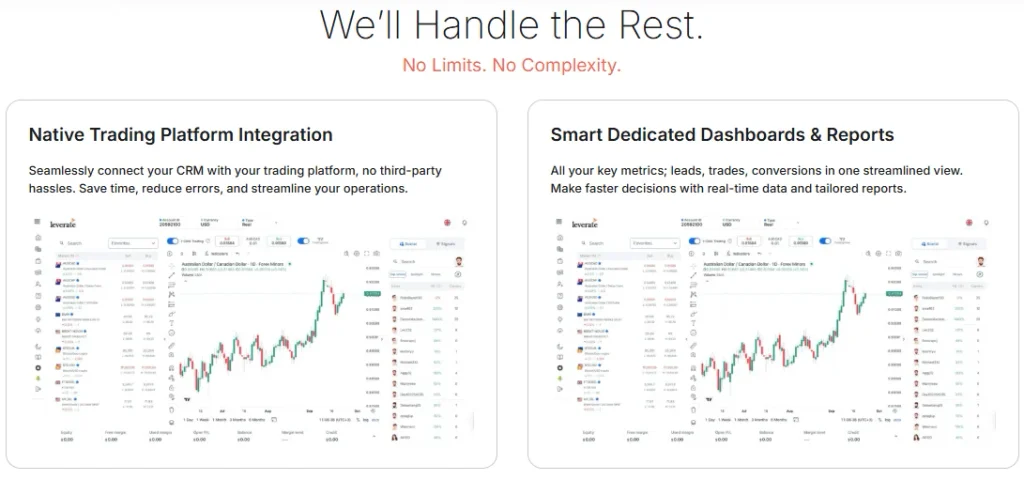
LXCRM is Leverate’s own CRM, built to integrate tightly with the wider Leverate ecosystem, including the Sirix trading platform. Founded in 2008, Leverate brings real industry depth, and LXCRM reflects that with smart dashboards, lead scoring, multi-channel outreach across email, SMS, and WhatsApp, and detailed team performance tracking. Budget Forex CRM Solutions for Brokers can still cover the essentials for a brokerage in its first year.
If you’re already running Leverate’s white-label solutions or the Sirix platform, LXCRM gives you the tightest possible integration available. It also works with standard MT4/MT5 setups, so it’s not locked exclusively to Leverate infrastructure, but the real value shows up for brokers already inside that ecosystem.
Some crm solutions for forex trading business platforms charge setup fees that rival a full year of subscription cost. Compliance-heavy Forex CRM Features are usually the first thing a Tier-1 regulated broker should verify.
Pros: deep Sirix and Leverate ecosystem integration, strong lead scoring and multi-channel outreach, solid access control for different user roles. Cons: highest starting price on this list (~$3,000/month), value drops for brokers outside the Leverate stack.
For a brokerage already committed to Leverate’s infrastructure, LXCRM is the best CRM for forex trading simply because nothing else integrates as tightly. Brokers that choose CRM for forex trading platforms without a real demo tend to switch again within a year.
Other Notable Forex CRM Providers Worth a Look
A few more names come up often enough to mention, even without a full review. Skale CRM focuses on both forex brokers and prop trading firms, with friction-less deposits and dedicated challenge-management tools for the prop model. Cloud Forex CRM leans hard into AI automation, with an AI-powered chatbot and over 200 brokers already on the platform.
CurrentDesk stands out for reporting depth, giving finance teams detailed dashboards on revenue and client behavior. EAERA offers a cloud-based option with AI client segmentation and automated KYC/AML built in. And DivulgeTech, based in Limassol, Cyprus, builds fully custom CRM systems with deep native MetaTrader integration for brokers that have outgrown packaged software entirely.
Plenty of brokers assume the best CRM for forex trading is whichever platform their competitor uses, which is rarely a sound reason to choose one. A brokerage that skips a real demo before picking the best CRM for forex trading usually pays for it within a year.
Forex Broker CRM for Crypto Trading
Brokers that offer both FX pairs and digital assets need a slightly different checklist. A forex broker crm for crypto trading setup has to handle wallet management across fiat and crypto at once, connect to cryptocurrency exchange platforms for liquidity and settlement, and apply KYC rules that satisfy both traditional financial regulators and the newer frameworks that cover digital assets.
B2Core remains the clearest example here, since its wallet architecture was designed from the ground up to treat crypto and forex as equal citizens rather than an afterthought bolted onto a forex-only system. A crm for trading that can’t sync trading data in real time isn’t worth the monthly fee.
If crypto is only a small part of your offering today but you expect it to grow, it’s worth asking any vendor on your shortlist how their roadmap handles digital asset wallets — retrofitting that later is far more painful than building on a platform that already supports it. The smartest way to choose CRM for forex trading software is to map your stage before you compare vendors.
CRM Solutions for Forex Trading Business: Small vs. Large Brokerages
The right crm solutions for forex trading business setup depends heavily on your size. For a small brokerage, look for something simple to deploy, affordable, and focused on the essentials — client onboarding, lead tracking, and KYC — without a steep learning curve. Brokeret, UpTrader, and FYNXT’s startup configuration all fit this profile well. A vendor’s award badges say less about the best CRM for forex trading than a single working demo does.
For a large or established brokerage, priorities shift. You need a system that handles bigger client volumes, connects to multiple trading platforms at once, and gives finance and compliance teams advanced reporting. Multi-tier IB structures with sub-IBs and master IBs earning commissions across several levels start to matter a lot more than the monthly subscription cost — plenty of lighter systems need manual reconciliation once that complexity shows up, which creates exactly the kind of operational drag a CRM is supposed to remove. The right Forex CRM for Your Brokerage should match your regulatory jurisdiction, not just your budget.
| Brokerage Stage | Priority | Recommended Fit |
|---|---|---|
| Startup / launch phase | Speed, low cost, core KYC + MT4/MT5 | Brokeret, UpTrader, FYNXT |
| Growth stage | IB automation, retention tools, PSP breadth | AltimaCRM, B2Core, FXBO |
| Enterprise / regulated | Compliance depth, audit trails, multi-brand | Syntellicore, TradeCore, Panda Forex CRM |
Forex CRM for Your Brokerage: Matching Type to Growth Stage
The right forex crm for your brokerage changes as the business itself changes, so it helps to think in four stages rather than one fixed shortlist. Not every forex broker crm for crypto trading platform supports the KYC rules that crypto regulators now require. Ask what happens if you need to leave — the best CRM for forex trading should never lock your data in.
Stage 1 : launch phase
Prioritize fast setup, transparent pricing, and a low minimum commitment. A packaged SaaS CRM with MT4 or MT5 connectivity out of the box and a basic IB module is usually the right starting point. The best CRM for forex trading choice today should still make sense for the brokerage you plan to be in three years. The best CRM for forex trading rarely requires the most add-ons — it requires the fewest workarounds.
Stage 2 : growth phase
As your partner network and client volume grow, evaluation shifts to multi-tier commission structures, partner portal quality, and payment provider breadth. White-label CRMs and enterprise automation platforms get evaluated most often at this stage. The Forex CRM for Your Brokerage that fits today may not be the one that fits in two years, so ask about the upgrade path. Every provider claims scalability, but the best CRM for forex trading proves it under real client volume, not a sales deck.
Stage 3 : enterprise and multi-asset
Deep integration requirements, dedicated infrastructure, multi-asset support across forex and crypto, and ISO-certified operational environments become the deciding factors. A platform that’s the best CRM for forex trading for MT4 shops may lag badly on cTrader or DXtrade connectivity.
Stage 4 : custom-requirement brokers
Once packaged software constrains your workflows or your MT4/MT5 integration depth, a specialist custom-built solution becomes the more defensible long-term path. The Best Forex CRM Software for one broker can be the wrong pick entirely for another, which is why stage matters more than star ratings.
A quick way to check fit: if a forex crm for your brokerage still forces manual work-arounds for your current stage, it’s the wrong type, not just the wrong vendor. Every provider in this comparison has a case for being the best CRM for forex trading — the right one depends entirely on your setup. Brokers moving from a generic tool to a purpose-built one usually describe the switch as finally finding the best CRM for forex trading for their business.
How to Choose CRM for Forex Trading: An 8-Point Checklist

Once you know your platform type, the next step is to choose crm for forex trading software using a consistent framework rather than a gut feeling from one flashy demo. Here are the eight points worth checking against every vendor on your shortlist. Test onboarding, IB commissions, and reporting before you commit to any Forex CRM for Your Brokerage. A written implementation plan is a better signal of the best CRM for forex trading than any marketing testimonial.
1. MT4/MT5 integration depth
Confirm native, real-time sync — not a third-party bridge — with your trading platform, and ask whether it supports multiple servers at once. Everything downstream depends on this working correctly. A platform’s integration count means little if it doesn’t cover the best CRM for forex trading criteria that matter to your business specifically.
2. IB and partner management
If partners drive meaningful volume, count how many commission tiers you actually need today and in two years, then confirm the platform supports that depth natively. A fixed two- or three-tier ceiling will constrain growth fast. Reviews calling a single vendor the best CRM for forex trading across the board should be read with some caution. The best CRM for forex trading question gets easier to answer once you write down your real bottleneck on paper first.
3. KYC/AML tooling
Check integrations with established providers like SumSub, Onfido, or Shufti Pro, the speed of automated verification, and whether the system generates a compliance-grade audit trail. A platform can look like the best CRM for forex trading on paper and still fail under real trading volume.
4. Payment gateway connectivity
The number of supported PSPs directly affects deposit conversion. Verify coverage across fiat and crypto payment methods for your specific target regions. Most roundups of the Best Forex CRM Software on the market rely on the same handful of criteria covered above.
5. Reporting and analytics
Real-time dashboards, automated P&L, and exportable compliance reports should be baseline, not a paid add-on. Multi-asset brokers should confirm reporting covers every asset class in one unified view. B2Core remains the clearest example of a forex broker crm for crypto trading built from the ground up, not bolted together.
6. Deployment model
Cloud SaaS, dedicated infrastructure, or fully custom — each affects data residency, migration difficulty, and how quickly you can switch providers later if needed. Ask three or four current clients of any vendor before you decide they run the best CRM for forex trading for your specific model.
7. Regulatory compliance posture
A broker under CySEC, FCA, or ASIC oversight needs very different audit and reporting tools than an offshore operation. Verify this against your actual license, not general marketing claims. Automation-focused Forex CRM Features cut the most manual work for a growing sales and retention team. Vendors love to call themselves the Best Forex CRM Software in their own marketing copy, so verify every claim in a live demo.
8. Implementation and support
Ask for the onboarding timeline, SLA terms, and whether you get a dedicated account manager or just a ticket queue. A vendor that can’t provide a reference client in your regulatory jurisdiction is a red flag. Support quality after go-live is a bigger factor in the best CRM for forex trading decision than most brokers expect going in. The right Forex CRM Solutions for Brokers pick changes as your IB network and client volume grow.
This is the same checklist worth applying to every crm system for forex trading you demo, regardless of how polished the sales deck looks — ask the provider to show the actual workflow end to end rather than describe it in slides. Compare crm solutions for forex trading business options on real client onboarding speed, not marketing claims.
Avoid the common trap of choosing purely on today’s needs. A system that looks fine for your first two hundred clients can become a bottleneck fast once you add more brands, jurisdictions, PSPs, or affiliates — and switching a crm system for forex trading mid-operation means migrating client data and compliance records, which is costly and genuinely risky.
Pick something built to scale from day one, even if you don’t need every feature yet. The Forex CRM Features that matter most rarely show up on the front page of a vendor’s website. A vendor’s award badge rarely proves it’s the best CRM for forex trading for your exact regulatory setup.
Forex CRM Pricing: What to Expect
Pricing for the best CRM for forex trading typically falls into a few bands. Entry-level solutions for smaller operations run roughly $500 to $1,000 a month. Mid-tier platforms serving growing brokerages land between $1,500 and $2,500 a month.
Enterprise-grade systems with full customization can reach $5,000 to $15,000 or more per month, and most providers in that tier require a custom quote rather than publishing a rate card. Affordable crm solutions for forex trading business needs rarely include every advanced feature out of the box.
On top of the subscription, budget for setup fees — anywhere from $1,000 to $20,000 depending on complexity — plus possible per-client or per-user charges. Watch for hidden costs too: integration fees for third-party KYC or payment services, customization development work, training, and data migration if you’re switching from another system. A forex broker crm for crypto trading needs unified wallets that treat fiat and digital assets the same way.
Frequently Asked Questions
Which CRM is best for forex brokers?
There’s no single universal answer — the best CRM for forex trading depends on your stage and jurisdiction. B2Core suits brokers running both forex and crypto. FYNXT fits brokers at any growth stage thanks to its modular, ISO-certified architecture. Syntellicore leads for Tier-1 regulated brokers needing deep compliance tooling. Brokeret and UpTrader work well for startups that want speed and lower cost.
When you compare forex CRM providers side by side, the honest answer almost always comes back to fit over features. Don’t let a single feature demo convince you a platform is the best CRM for forex trading before you’ve tested support response times too.
What are the top 5 CRMs?
Based on integration depth, compliance tooling, and real-world adoption, five names consistently lead comparisons in 2026: B2Core, FYNXT, Syntellicore, FXBO, and AltimaCRM. Each one leads in a different category rather than one clear overall winner. Some forex trading crm features only pay off once a brokerage passes a certain client volume.
What is a CRM in forex trading?
The best CRM for forex trading is software built to manage the entire client relationship at a brokerage — lead capture, KYC and AML onboarding, trading account sync, deposits and withdrawals, IB and affiliate commission tracking, and compliance reporting — all connected to a trading platform like MT4 or MT5 in real time. In short, it’s the core crm for trading operations that everything else at a brokerage runs through.
Every one of the Forex CRM Solutions for Brokers reviewed here connects natively to at least MT4 or MT5. Cheap Forex CRM Software for Brokers usually cuts corners on KYC automation first, since that’s the hardest part to build well.
Which apps do most forex traders use?
On the trading side, MetaTrader 4 and MetaTrader 5 remain the most widely used platforms worldwide, with cTrader, DXtrade, and TradeLocker gaining ground. On the brokerage side, the CRM sits behind the scenes and isn’t something the trader interacts with directly — it powers the account creation, KYC, and support that make the trading app work smoothly. A crm system for forex trading with weak reporting will cost your finance team hours every single week.
Can AI do forex trading?
AI tools can analyze price data, flag patterns, and even execute trades automatically through algorithmic strategies, but fully autonomous AI trading still carries real risk and no system guarantees profit. Many modern forex CRM platforms use AI for client-facing tasks instead — KYC verification, churn prediction, and lead scoring — rather than for the trading decisions themselves. The best CRM for forex trading rarely wins on price alone — integration depth and compliance tooling matter more over time.
What is MT5 CRM software?
MT5 CRM software is a customer relationship platform built to sync natively with the MetaTrader 5 trading engine — pulling account balances, trade history, and client activity into the CRM in real time so sales, support, and compliance teams can act on live data instead of static reports. Most best forex CRM software platforms treat MT5 connectivity as a baseline requirement rather than a premium feature. Reporting-focused Forex CRM Features separate a broker-grade platform from a generic sales tool fastest.
What software do forex traders use?
Individual traders mainly use MetaTrader 4, MetaTrader 5, cTrader, or TradingView for charting and execution. Brokerages, on the other hand, run forex CRM software for brokers behind those platforms to manage the client side — onboarding, compliance, and account operations that traders never see directly.
The best CRM for forex trading changes less often than brokers think — most switches come from poor initial fit, not the software falling behind. The best CRM for forex trading for today’s client volume might not be the right fit once you double in size.
Is it possible to make $1000 a day in forex?
It’s technically possible with a large enough account and the right conditions, but it’s not realistic or typical for most traders, especially beginners, and it carries significant risk of equally large losses. Consistent, smaller returns managed with proper risk control are a far more sustainable goal than chasing a fixed daily dollar target. Generic CRMs for Forex Brokers that were never designed for the industry tend to break under real trading volume.
Do forex CRMs work for brokers offering both forex and crypto?
Yes — this is exactly what a forex broker crm for crypto trading setup is built for. Look for a platform with unified fiat and digital-asset wallets, KYC rules that satisfy both traditional and crypto-specific frameworks, and connectivity to the cryptocurrency exchange platforms you use for liquidity. B2Core is the clearest example of this design done well. The right crm for trading connects sales, compliance, and finance without forcing them into separate systems.
How long does it take to set up CRMs for forex brokers?
Packaged, cloud-based CRMs for forex brokers typically go live in one to two weeks for a standard configuration. Custom-built systems with deep MT4/MT5 integration or heavy compliance customization can take several months, depending on scope. Most CRMs for Forex Brokers now publish at least a starting price, even if the final number needs a sales call.
Conclusion
The best CRM for forex trading isn’t the platform with the longest feature list — it’s the one that matches your brokerage’s stage, regulatory footprint, and growth plan. A startup gains more from a two-week go-live and clean KYC automation than from thirty-tier IB structures it doesn’t need yet. A Tier-1 regulated enterprise gains more from automated MiFIR and EMIR reporting than from the fastest deployment clock on the market.
Shortlist two or three providers from this comparison, request real demos, run an actual client through the onboarding flow, and check the numbers against your own compliance requirements before you sign anything. Budget alone rarely points you to the best CRM for forex trading — jurisdiction and IB structure matter just as much.